
Living in Zürich
Zurich pairs a strong professional and startup base with a smaller-city feel. Typical local employee pay is high, but mild summers do not prevent a long grey season, with 160 bright days and 148 rainy-grey days each year. The trade-off is the sky.
Zürich at a glance
Vital stats
Where Zürich stands out
The metrics where Zürich sits farthest from the middle worldwide, good and bad.
Cheap to arrive, expensive to stay?
A typical one-bedroom in Zürich runs CHF 1,847/mo. That is ~28% of one typical local employee’s mean net pay. That is 4 points above Zug, its closest rival among nearby cities. This is a solo-newcomer stress test: sitting tenants, shared homes, subsidised housing and informal rents are deliberately outside the numerator.
The fastest way to test a shortlist is to go. A week on the ground tells you things no ranking can.
Partner link
Approved language-learning and international money resources for practical next steps.
Daily life in Zürich
How Zürich scores
Category by category
Affordability
54/100Zürich's open-market one-bedroom rent on a new lease is about CHF 1,847 per month. That is roughly 28% of one typical employee's mean net pay, a rent burden labelled manageable solo.
Climate
wet & greyZurich's summers are mild, with July near 20°C, but the year is often wet and grey. It records 148 rainy-grey days and has limited winter brightness, so the darker season can feel long. Clean air and very little extreme weather soften the trade-off, and muggy days remain relatively uncommon.
Nature access
great hikingFor outdoor access this city is hard to beat. The lake sits in the middle of town, rivers run through it, and forests, hills, and serious hiking start close to the edges. Weekend trips into the Alps are a normal part of life here. The one gap is the sea, which is a long drive away, and dense in-city green space is more modest than the surrounding wildness suggests.
Urban form
mid-sizedZurich is a compact city of about 437,000 people, with a metro population under 700,000. Daily life is easy on foot and car dependence is low. The trade-off is space: apartments tend to be small, even as the outer districts remain polished.
Public life & spaces
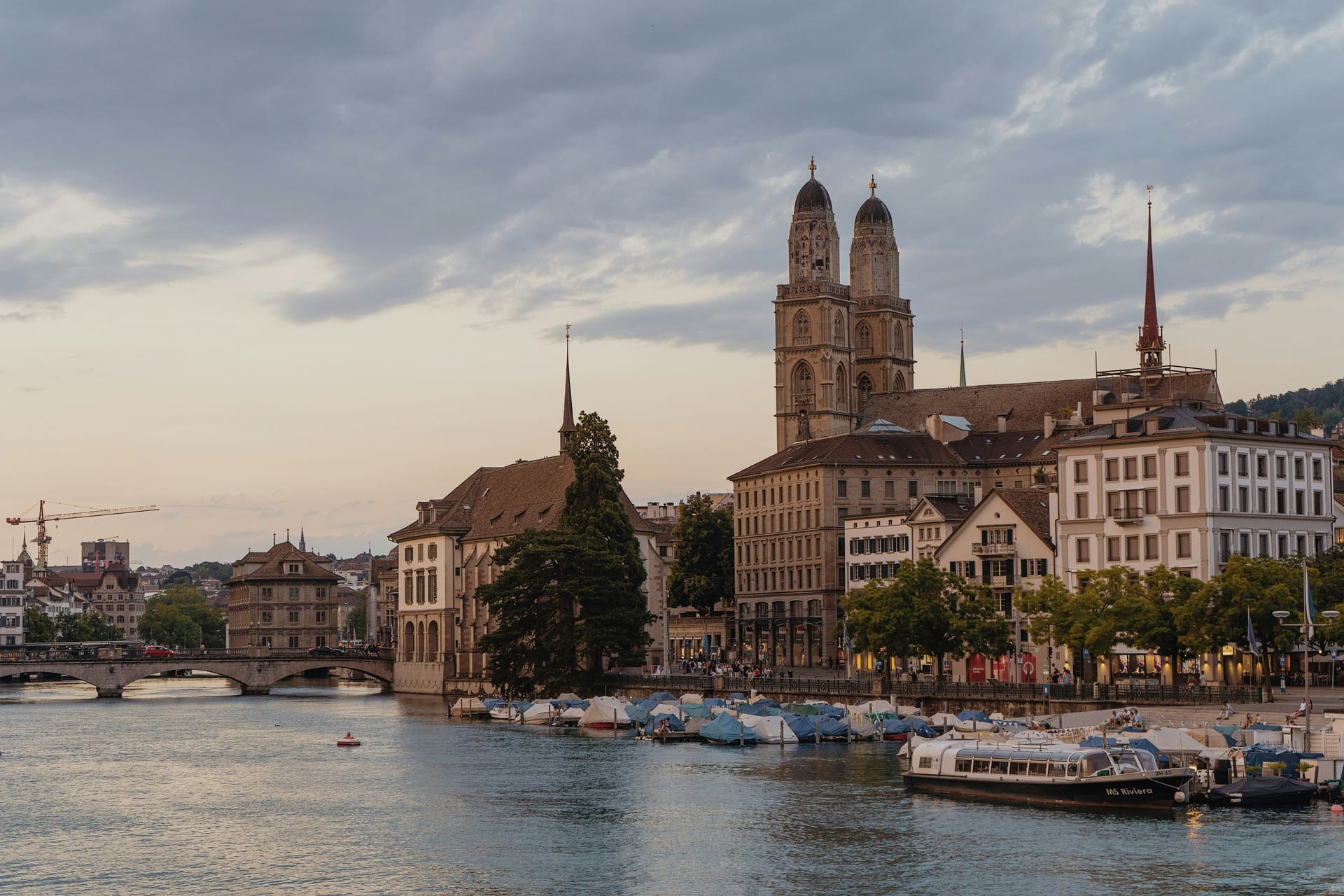
89/100Zurich is immaculate, meticulously maintained down to the last kerb. The lakefront, the riverside swimming and tidy squares are lovely if smaller in scale. Free lake swimming is the great equaliser, but this is among the world's most expensive cities, so most other daily pleasures come at a steep price.
Safety
90/100Few cities feel as secure. Violent crime is rare, the streets are calm after dark, traffic is well-managed, and the political backdrop is about as stable as it gets. Petty theft exists, as in any prosperous hub, but stays low by European standards. Walking home late simply is not a worry most residents carry.
Healthcare
75/100The medical system is excellent at the point of care: top-tier hospitals, reliable emergency response, and plenty of doctors who handle consultations in English. The catch is the system around it. Health insurance is mandatory, privately run, and confusing to set up, and out-of-pocket exposure can sting. Quality is rarely the problem; navigating the paperwork and the bills is.
Family life
69/100For raising children, the fundamentals are strong: very safe streets, good schools, abundant playgrounds, and an outdoor culture that gets kids into nature early. Work-life balance is respected. The hard parts are practical and expensive, though. Childcare is costly and scarce, family-sized housing is tough to find and afford, and statutory parental leave is thin compared with the rest of Western Europe.
Career
78/100Zurich combines a strong local market with good industry fit and unusually dense professional and startup networks. Typical pay for local employees is high, and English works in many settings. Fully remote roles are less common, while German still broadens the market.
Culture & food
71/100The cultural offering is solid and well-funded rather than overwhelming: good restaurants, decent cafés, a respectable museum and music scene, and a manageable nightlife. It is more measured than Berlin's around-the-clock energy. The dining is varied, vegetarian and vegan options are easy to find, and there is a steady international crowd, but this is not a city people move to chasing a wild night out.
Ease of integration
70/100German is the working language, though the everyday speech is Swiss German, which can keep outsiders at arm's length even when their textbook German is fine. English is widely spoken and goes a long way day to day. Civic trust and orderliness run extraordinarily high, and the city is diverse and international. Locals can be reserved at first, and openness to foreigners is moderate rather than effusive.
Connectivity
75/100This is close to a benchmark for how a city should run. Public transport is dense, punctual, and reaches everywhere; utilities never fail; trains connect cleanly to the rest of the country and beyond. The airport is well-linked for a city this size. Cycling infrastructure lags the transit standard, and government services have been slower to move online than the country's reputation might suggest.
Social values
progressiveCivic life is built on trust, order, and rule-following, and the city is diverse and broadly welcoming to LGBTQ residents. On the wider social spectrum it leans more moderate than progressive: socially liberal attitudes and openness to foreigners sit in the middle rather than at the front, and the culture is less self-consciously countercultural than Berlin. Traditional in some habits, modern in its tolerance.
Relocation ease
56/100Moving here is one of the harder European relocations to pull off. As a non-EU country, Switzerland keeps visa and work permits tightly controlled, and the housing hunt is notoriously brutal, with high competition and demanding landlords. The offsetting good news: banking and admin setup are smooth, day-to-day bureaucracy is comparatively light, and English smooths the early months even though Swiss German takes longer to crack.
The trade-offs
A year in Zürich
Jul peaks around 25°C, Jan days top out near 4°C, and the year brings roughly 160 bright days.
Can you actually move here?
The hard limits people most often bring to a move, scored against Zürich's data.
Moving with a pet
Bringing a pet to Zürich is straightforward. Switzerland follows clear, well-run import rules, so with standard vaccinations and microchipping in order, the process is among the easier parts of an otherwise demanding move.
Who Zürich works for
Answer the questionnaire and see where Zürich lands for you.
Take the free questionnaireWhere else to look
Zürich vs. comparable cities
The cities people weigh against Zürich
Unexpected siblings
Far from Zürich on the map, close across all 14 categories of daily life.

