
Living in Austin
Austin combines strong career prospects with a bright climate, but the climate has a hard edge. Local pay is high by this comparison's standards, while long muggy summers and weather risk shape everyday life here, even for people who value the career upside.
Austin at a glance
Vital stats
Where Austin stands out
The metrics where Austin sits farthest from the middle worldwide, good and bad.
Cheap to arrive, expensive to stay?
A typical one-bedroom in Austin runs $1,412/mo. That is ~30% of one typical local employee’s mean net pay. This is a solo-newcomer stress test: sitting tenants, shared homes, subsidised housing and informal rents are deliberately outside the numerator.
The fastest way to test a shortlist is to go. A week on the ground tells you things no ranking can.
Partner link
Approved language-learning and international money resources for practical next steps.
Daily life in Austin
How Austin scores
Category by category
Affordability
66/100Austin's open-market one-bedroom rent on a new lease is about $1,412 per month. That is roughly 30% of one typical employee's mean net pay, a rent burden labelled manageable solo.
Climate
mediterraneanAustin has bright winters and about 222 bright days a year, but summer dominates the climate. July averages around 30°C, and muggy conditions are common for much of the warm season. Air quality is generally clean, though storms and flooding add a real weather risk.
Nature access
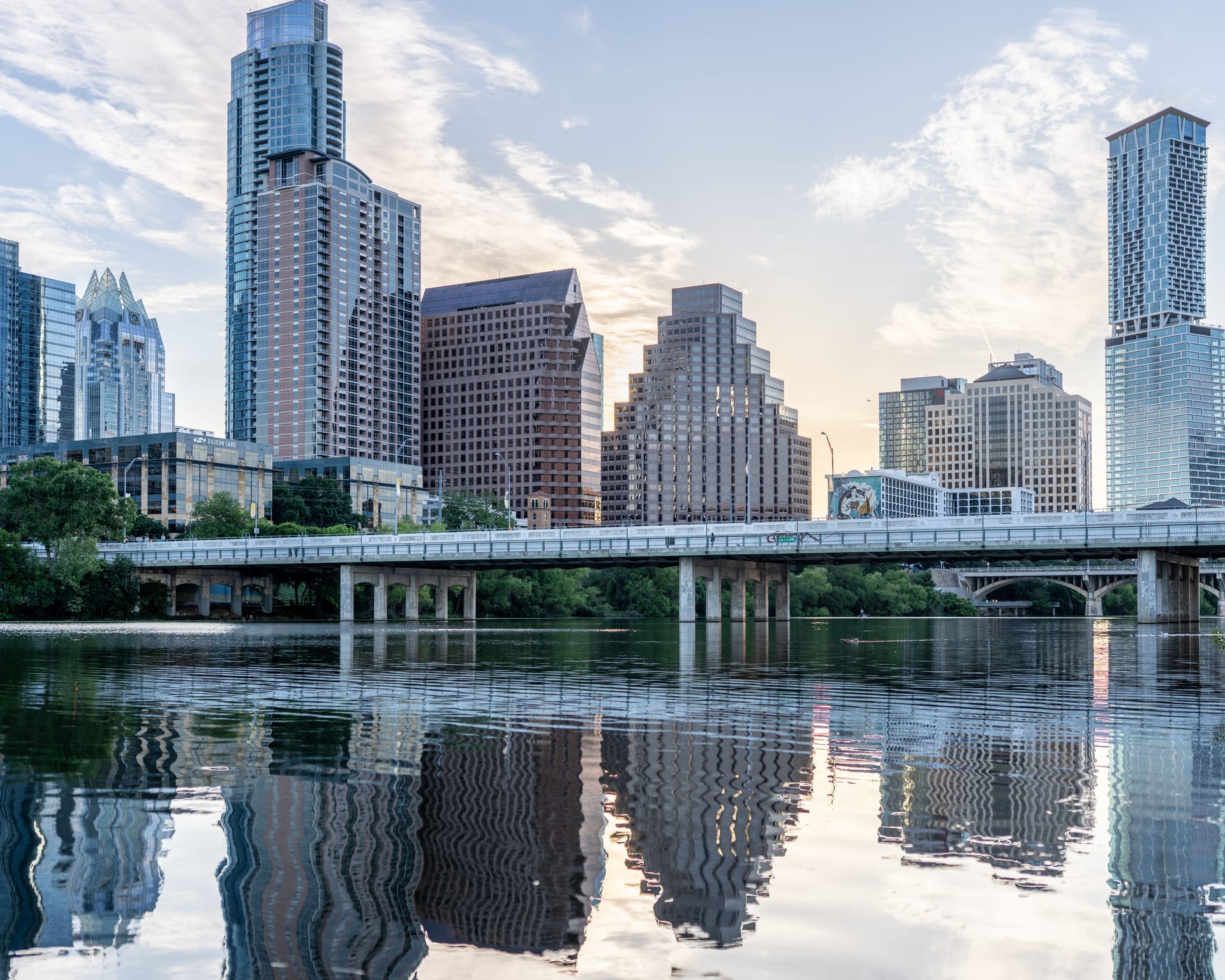
lakes & riversThis is flat inland country, so the big-ticket landscapes are missing. No coast, no mountains, and only modest forest within reach. What Austin does have is water at its centre, with the Colorado River and a chain of lakes threading through town, plus good trails for cycling and running. For weekend escapes into wilderness, though, it trails the more scenically blessed parts of the country.
Urban form
mid-sizedSprawling and built around the car, with low density and walkability that frustrate anyone hoping to live without driving. The trade-off is space: homes and yards are generous, and the residential neighbourhoods and outer suburbs are pleasant and well regarded. The pace is relaxed rather than frenetic, closer to a big town that kept growing than a tightly wound metropolis.
Public life & spaces
56/100Austin is affluent and fairly clean, though the sprawl grows faster than the upkeep. It is a car city — the lakefront and a slowly improving downtown are the exceptions, not the rule. The live-music scene and festivals give it genuine free energy, but rents and prices keep climbing.
Safety
63/100Broadly safe by the standards of a mid-size American city, with serious violent crime relatively contained. Petty crime, the car break-ins and opportunistic theft common to fast-growing US cities, is the more realistic everyday concern. Most residents feel comfortable day and night, and the streets read as calm rather than edgy.
Healthcare
54/100The clinical care is solid, with reliable emergency services, good hospitals and, being the US, no language hurdle at the front desk. The catch is the system around it. Insurance is a maze to navigate, and out-of-pocket costs can be brutal for anyone caught without strong coverage. Specialist doctor availability is only middling for a city this size.
Family life
42/100A genuinely good place to raise children outdoors, with strong parks, playgrounds and decent neighbourhood schools. The weather lets kids spend much of the year outside, and the suburbs are family-friendly. The weak spots are American structural ones: childcare is expensive and hard to find, and paid parental leave is thin compared with most of the developed world.
Career
84/100Austin has a strong local market, with deep professional networks, a strong technology ecosystem, and plenty of English-language roles. Typical local pay is high by this comparison's standards, while low unemployment and remote-friendly work support both conventional and flexible careers.
Culture & food
81/100This is where Austin shines. The live music scene is among the best in America, the food runs from world-class barbecue to serious Tex-Mex and an inventive restaurant culture, and nightlife and cafes are everywhere. Museums and big institutional culture are thinner than in New York or Los Angeles, and the international dining edge is more limited, but the homegrown creative energy more than carries it.
Ease of integration
74/100English is the default and Spanish is widely present, so newcomers face no language wall and can settle in quickly. Texan friendliness makes casual connection easy, and the city leans open and welcoming. It is less of an international melting pot than the big coastal cities, though, so expats may find a smaller ready-made global community than they would in New York or LA.
Connectivity
44/100The infrastructure story is uneven. Internet is fast and reliable, and traffic, while present, is lighter than in the coastal megacities. But public transport is sparse, intercity rail is essentially absent, and the airport, while serviceable, lacks the global reach of the major hubs. In practice, a car is close to mandatory.
Social values
progressiveA reliably progressive island within a conservative state, more liberal and secular than its Texan surroundings while still more traditional than the coastal metros. The culture is open to newcomers and broadly accepting on social questions. On gender and diversity it reads as moderate, welcoming but not as cosmopolitan as New York or Los Angeles.
Relocation ease
55/100The hard part is getting in. US visas and work authorization are notoriously demanding, which is the main barrier for anyone arriving from abroad. Once settled, daily admin is manageable: the language is no obstacle, banking and housing are navigable, and the lack of a state income tax keeps tax filing simpler than in most American cities.
The trade-offs
A year in Austin
Aug peaks around 37°C, Jan days top out near 17°C, and the year brings roughly 222 bright days.
Can you actually move here?
The hard limits people most often bring to a move, scored against Austin's data.
Moving with a pet
Bringing a pet into the US is relatively straightforward, mostly a matter of vaccination records and basic paperwork rather than long quarantines. Austin itself is notably pet-friendly, with plenty of dog-welcoming spaces and outdoor life.
Who Austin works for
Answer the questionnaire and see where Austin lands for you.
Take the free questionnaireWhere else to look
Austin vs. comparable cities
Objective scores (0–100) for Austin and its 4 nearest comparable cities.
The cities people weigh against Austin
Unexpected siblings
Far from Austin on the map, close across all 14 categories of daily life.