
Living in Marbella
A Costa del Sol resort town that runs on sun, sea and a large international set, more leisure colony than working city. Days are mild and bright, the beaches sit right there, and English is everywhere. Where Málaga down the coast has a real urban centre and an airport feeding it, Marbella stays small, low-rise and oriented around the seafront.
Marbella at a glance
Vital stats
Where Marbella stands out
The metrics where Marbella sits farthest from the middle worldwide, good and bad.
Cheap to arrive, expensive to stay?
A typical one-bedroom in Marbella runs €877/mo. That is ~46% of one typical local employee’s mean net pay. That is 4 points above Seville, its closest rival among nearby cities. This is a solo-newcomer stress test: sitting tenants, shared homes, subsidised housing and informal rents are deliberately outside the numerator.
The fastest way to test a shortlist is to go. A week on the ground tells you things no ranking can.
Partner link
Approved language-learning and international money resources for practical next steps.
Daily life in Marbella
How Marbella scores
Category by category
Affordability
69/100Marbella's open-market one-bedroom rent on a new lease is about €877 per month. That is roughly 46% of one typical employee's mean net pay, a rent burden labelled tight alone.
Climate
mediterraneanMarbella offers about 281 bright days and few rainy-grey days, with mild winters and warm summers. Coastal humidity still brings some sticky days, but the darker, wetter season is short and the air remains relatively clean.
Nature access
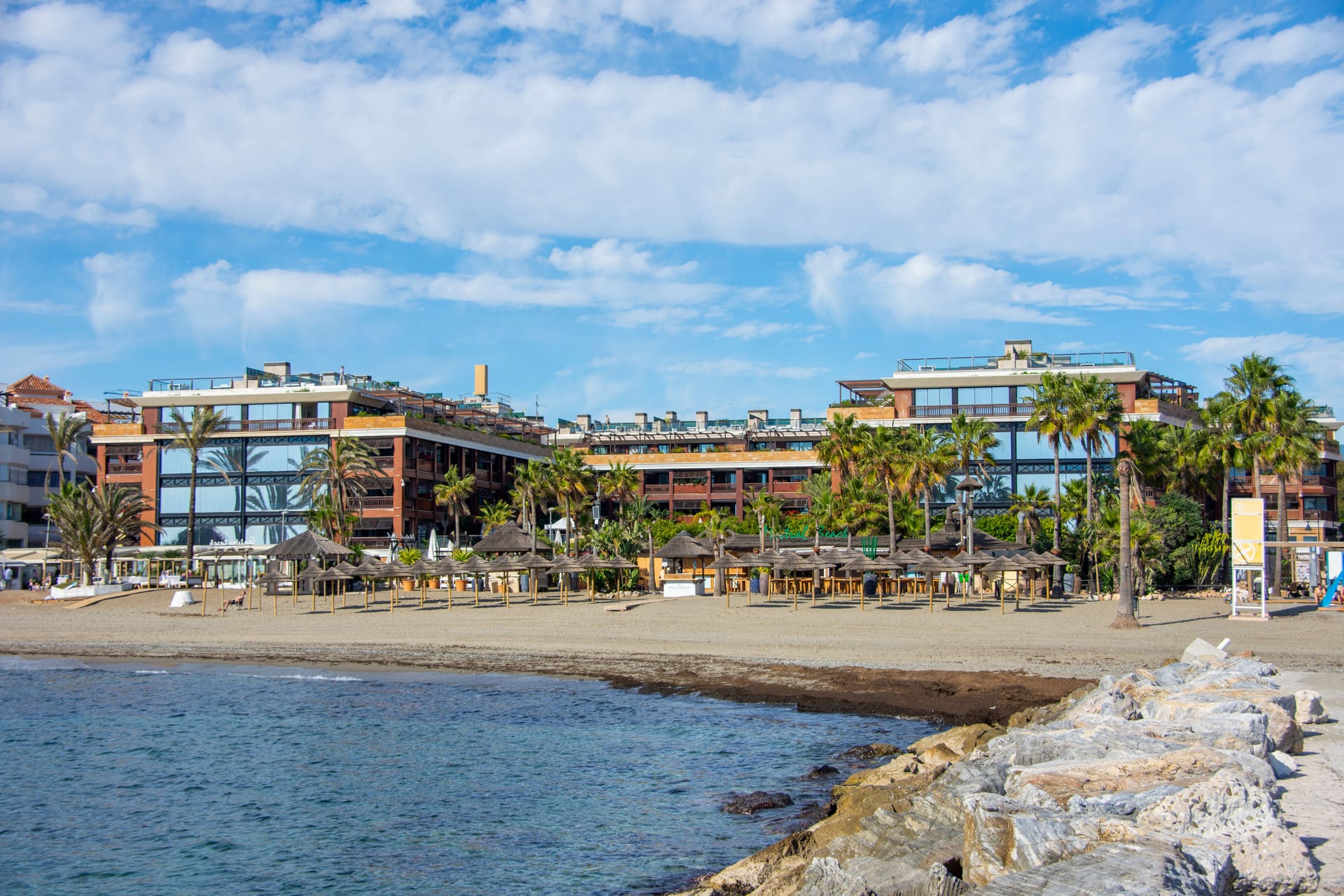
coastalThe beach is the whole point and it delivers completely, a long stretch of coast that anchors daily life. Behind the town the Sierra Blanca rises fast, giving hikers and weekend explorers real mountain ground within minutes, and the wider Andalusian backcountry sits close. Inside the town itself green space is thin, with few proper parks, so the outdoors here means coast and hills rather than lawns.
Urban form
small cityMarbella is small and spread along the shore, closer to a string of resort neighbourhoods than a dense city. Getting around really wants a car; walking works in pockets like the old town and the marina but not across the whole place. The pace is slow and seasonal, swelling in summer and quieting off-season, with comfortable suburbs and decent residential quality but little of the everyday urban texture of a Spanish capital.
Public life & spaces
74/100Marbella is manicured and well-tended, its promenade and old town kept to a wealthy resort's standard. The pretty old quarter and seaside paseo are lovely, but resort sprawl surrounds them and grand squares are few. The real catch is money: this is an expensive, pay-to-play scene with little that's genuinely free.
Safety
73/100Safety is one of the strongest things going for it. Serious violent crime is rare, the roads are calm, and walking around after dark feels easy in most areas. Petty theft is the realistic concern, the usual resort-town pickpocketing that comes with crowds and tourists, so day-to-day life feels secure even if wallets need watching in season.
Healthcare
68/100Care quality is solid and the cost of falling ill is manageable, helped by Spain's public system alongside a busy private sector built for an international clientele. English-speaking doctors are genuinely easy to find here, more so than in most Spanish towns. Coverage thins out at the edges: finding a regular doctor can take patience, and emergency reliability is fine without being exceptional.
Family life
65/100For an outdoor childhood it is hard to beat, with beach, sun and space for kids to be outside most of the year, and a relaxed work-life rhythm that leaves time for it. Schools and childcare are adequate rather than standout. The catch is housing: family-sized homes are pricey and hard to land, which is the main thing that complicates settling in with children.
Career
45/100Marbella is a poor bet for a conventional local career. Typical local pay is relatively solid, but the job market and startup scene are narrow. English-language roles and remote work are the practical advantages, making the city easier for people with portable income than for those starting a local search.
Culture & food
61/100Social life leans toward the marina, the beach clubs and a lively nightlife scene aimed at a moneyed, international crowd. Eating out is good without being a destination for food, and the museum, music and arts side is modest, the trade-off for a small resort town rather than a cultural capital like Seville or Granada. The international community is enormous and English carries the social scene.
Ease of integration
78/100Plugging in as a newcomer is unusually easy here, with one of the largest foreign communities on the coast and English doing much of the daily work. The culture is open to outsiders and the adjustment is gentle. The flip side is that integrating into genuinely Spanish life takes more deliberate effort, since it is simple to live entirely within the international bubble and never need much Spanish.
Connectivity
47/100Utilities are dependable and digital connectivity is decent, but the connective tissue is where Marbella shows its limits. There is no train line worth the name and public transport is weak, so life realistically runs on a car. Málaga's airport handles the wider connections within a manageable drive, and local bureaucracy stays slow and only partly digitised.
Social values
progressiveSocially the town reads as relaxed and open, in line with Spain's broadly liberal outlook. It is welcoming to outsiders, comfortable for LGBTQ residents, and genuinely international in make-up. Andalusia carries a more traditional, religiously rooted undercurrent than Spain's big cities, though in a cosmopolitan resort town that edge is softer than inland.
Relocation ease
57/100The soft side of moving here is smooth: the language barrier is low thanks to widespread English, the culture is easy to settle into, and visa and work-authorisation routes are no harder than Spain generally. The friction is practical. Finding housing is genuinely tough in a tight, pricey market, and Spanish bureaucracy and banking admin demand patience.
The trade-offs
A year in Marbella
Aug peaks around 27°C, Jan days top out near 14°C, and the year brings roughly 281 bright days.
Can you actually move here?
The hard limits people most often bring to a move, scored against Marbella's data.
Moving with a pet
Bringing a pet is straightforward. Spain follows standard EU import rules, and the broadly pet-friendly, outdoor-leaning culture of the coast makes settling an animal in here about as easy as it gets.
Who Marbella works for
Answer the questionnaire and see where Marbella lands for you.
Take the free questionnaireWhere else to look
Marbella vs. comparable cities
The cities people weigh against Marbella
Unexpected siblings
Far from Marbella on the map, close across all 14 categories of daily life.