
Living in Marseille
France's oldest and second city, a Mediterranean port with a salt-air, unpolished character all its own. Rents sit far below Paris while the sea, the sun and the limestone hills are right there. The trade-off is a rougher edge: petty crime is real and the place rewards people who lean into its noise rather than fight it.
Marseille at a glance
Vital stats
Where Marseille stands out
The metrics where Marseille sits farthest from the middle worldwide, good and bad.
Cheap to arrive, expensive to stay?
A typical one-bedroom in Marseille runs €625/mo. That is ~26% of one typical local employee’s mean net pay. This is a solo-newcomer stress test: sitting tenants, shared homes, subsidised housing and informal rents are deliberately outside the numerator.
The fastest way to test a shortlist is to go. A week on the ground tells you things no ranking can.
Partner link
Approved language-learning and international money resources for practical next steps.
Daily life in Marseille
How Marseille scores
Category by category
Affordability
69/100Marseille's open-market one-bedroom rent on a new lease is about €625 per month. That is roughly 26% of one typical employee's mean net pay, a rent burden labelled manageable solo.
Climate
mediterraneanMarseille delivers a bright Mediterranean year, with 268 bright days and only 56 rainy-grey days. Winters are mild, and summers are warm rather than relentlessly hot, but sea air can feel sticky for long spells. Clean air is a genuine advantage, while wildfire smoke is the sharper climate risk.
Nature access
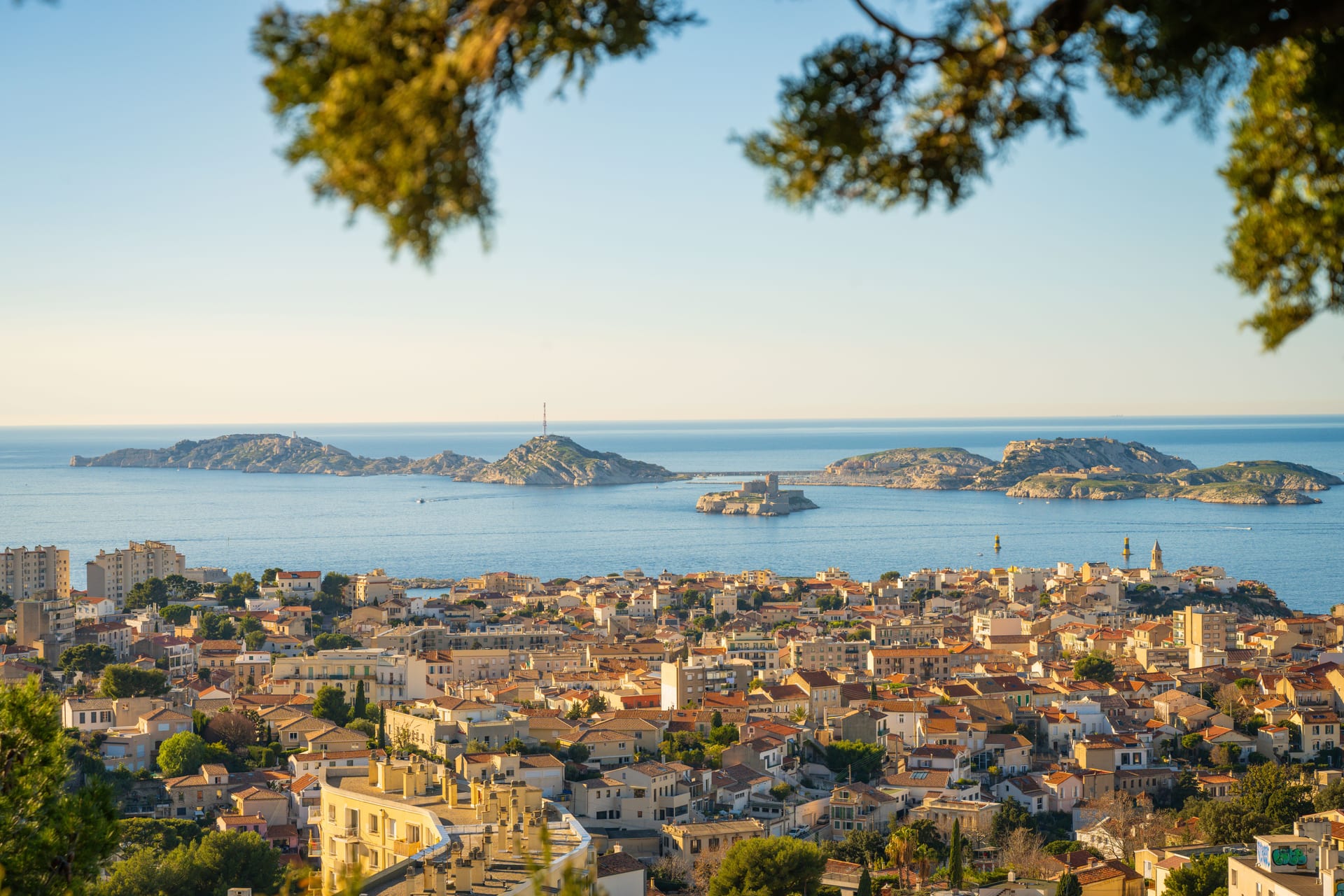
coastalThe sea defines daily life here, with calanques, coves and rocky beaches within easy reach and some of the best coastal access of any French city. Hiking in the white limestone hills and weekend escapes into Provence are genuine strengths. The weak spot is inside the city itself, where green space per resident is thin and parks are limited.
Urban form
mid-sizedA compact, human-scaled city after the sprawl of Paris, walkable in its core and built on a workable mix of homes, shops and life at street level. It is smaller and less dense than the capital, which suits people who want a big-city feel without the crush. Some outer districts feel neglected and a car still helps for the wider area.
Public life & spaces
52/100Marseille is gritty and unapologetic — litter and neglected blocks are part of the texture, and polish is rare. What redeems it is the sea: the Vieux-Port, the seafront, the Calanques on the doorstep, all alive and free. Life here is cheap and lived outdoors, beaches and street life for the taking.
Safety
55/100A mixed and honestly complicated picture. Serious violent crime tied to drug networks gives Marseille a reputation worse than most of France, and petty theft, pickpocketing and break-ins are a real daily concern. Many residents feel uneasy in parts of the city after dark. Traffic safety, by contrast, is reasonable.
Healthcare
66/100Backed by France's strong public system, with good hospitals, capable specialists and very low out-of-pocket costs once enrolled. Marseille anchors the region's medical care and handles emergencies well. Finding a GP can take patience given doctor shortages, and English-speaking practitioners are harder to come by than in Paris or northern Europe.
Family life
63/100An outdoor, sun-soaked place to raise children, with the sea, the hills and a relaxed work-life rhythm that French families lean on. State schools and childcare are solid and parental leave is generous by national norms. The honest caveat is safety, which sits below the French average and shapes where families choose to settle.
Career
58/100The local market is limited in breadth. Unemployment is 7.5%, English-language roles are scarce, and the startup scene is modest. Pay for typical local employees is comparatively solid. Remote work improves the picture, but local job-seekers should expect a narrower set of options.
Culture & food
72/100Marseille's fierce local identity is its strongest cultural asset, a port culture shaped by North African, Italian and Provençal layers and proud of being nothing like Paris. The food scene is excellent, from bouillabaisse to street-level North African cooking, and museums and music hold their own. French remains essential, as everyday English is limited.
Ease of integration
74/100French is the working language of daily life and getting by without it is hard, which slows integration for newcomers. That said, the city is one of the most diverse and outward-looking in France, long shaped by Mediterranean migration, and locals tend to be direct and welcoming once contact is made. Learning French is the real key to belonging.
Connectivity
60/100Reliable utilities, fast internet and excellent high-speed rail links north to Paris and Lyon are clear strengths. The airport connects well to Europe. Local public transport is the soft spot, thinner and patchier than the metro networks of Paris or Berlin, and cycling infrastructure lags. Administrative processes still run heavily on paper.
Social values
progressiveSecular, diverse and broadly progressive, in line with French public life and shaped by generations of Mediterranean arrivals. The city is open to outsiders and comfortable with difference, with attitudes on gender and LGBTQ life that are mainstream-liberal. It leans a touch less polished and orderly than Paris, more freewheeling in its everyday civic temperament.
Relocation ease
52/100Moving here means navigating French administration, which is famously slow and paper-bound, plus a tight rental market where finding a flat takes effort and persistence. The language barrier is significant without French. As an EU member, the legal path is standard for the bloc, though the day-to-day setup demands patience.
The trade-offs
A year in Marseille
Jul peaks around 27°C, Jan days top out near 11°C, and the year brings roughly 268 bright days.
Can you actually move here?
The hard limits people most often bring to a move, scored against Marseille's data.
Moving with a pet
Bringing a pet is straightforward. As an EU destination France follows the standard pet-passport rules, so a microchip, rabies vaccination and the right paperwork are usually all it takes for cats and dogs from most countries.
Who Marseille works for
Answer the questionnaire and see where Marseille lands for you.
Take the free questionnaireWhere else to look
Marseille vs. comparable cities
Objective scores (0–100) for Marseille and its 4 nearest comparable cities.
The cities people weigh against Marseille
Unexpected siblings
Far from Marseille on the map, close across all 14 categories of daily life.
