
Living in Almaty
Almaty has clear seasons, plenty of bright days and a genuinely cold winter. Summers are comfortable rather than oppressive, but the career market is narrow and English-language roles are limited. Local pay is low, so it suits people who value seasonal variety and can bring portable income.
Almaty at a glance
Vital stats
Shown in USD: the local currency (KZT) moves too fast for stable monthly figures.
Where Almaty stands out
The metrics where Almaty sits farthest from the middle worldwide, good and bad.
Cheap to arrive, expensive to stay?
A typical one-bedroom in Almaty runs $577/mo. That is ~90% of one typical local employee’s mean net pay. This is a solo-newcomer stress test: sitting tenants, shared homes, subsidised housing and informal rents are deliberately outside the numerator.
The fastest way to test a shortlist is to go. A week on the ground tells you things no ranking can.
Partner link
Approved language-learning and international money resources for practical next steps.
Daily life in Almaty
How Almaty scores
Category by category
Affordability
73/100Almaty's open-market one-bedroom rent on a new lease is about $577 per month. That is roughly 90% of one typical employee's mean net pay, a rent burden labelled solo unlikely.
Climate
continentalAlmaty brings bright, dry air and real seasons. Summers are warm without excessive heat, while January averages about -3°C. Winters are the trade-off, with colder, darker conditions despite generally clear weather and no muggy season.
Nature access
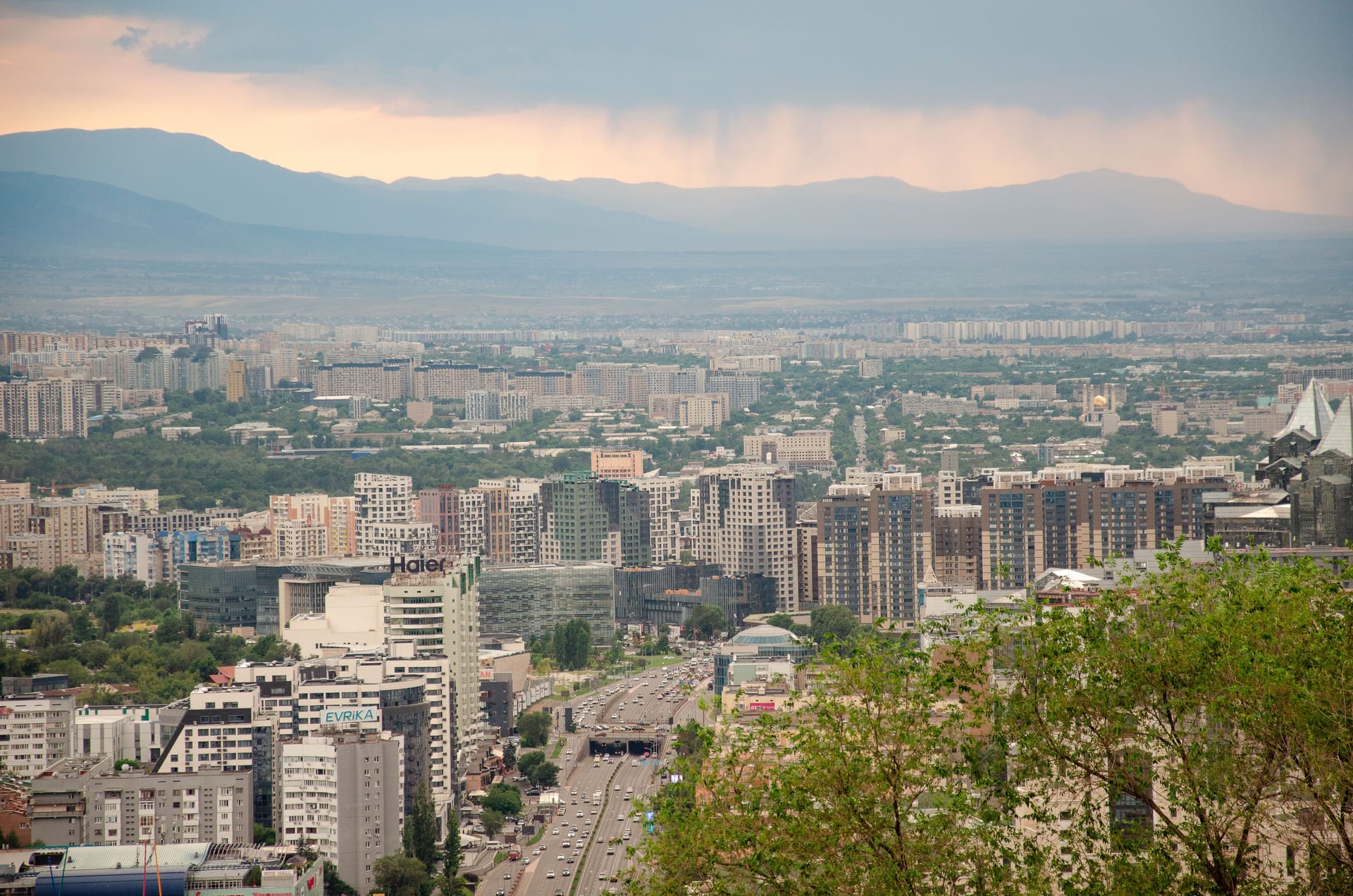
alpineThis is the city's strongest card by a wide margin. The Tian Shan rises straight out of the southern edge of town, putting world-class hiking, alpine lakes, and ski slopes within easy reach, and the famous Medeu and Shymbulak areas are a short drive up. Weekend escapes into real wilderness are routine here. The one gap is obvious: no coast, no sea.
Urban form
large cityA leafy, mostly low-slung grid laid out under the mountains, walkable enough in the core but spread out and increasingly built around the car as it pushes into the suburbs. The pace is unhurried for a city this size, far calmer than the megacities of South and Southeast Asia. Neighbourhood quality is solid in the central districts and thinner toward the edges.
Public life & spaces
67/100Almaty is orderly and tree-lined, noticeably cleaner than South Asia, with crisp mountain air. Its public realm is Soviet inheritance done well — Panfilov Park, leafy plazas and wide boulevards. Living is cheap, and much of the pleasure is free: parks, squares and the mountains rising right at the city's edge.
Safety
66/100Day-to-day safety is reasonable, with low violent crime and a generally calm street feel, on par with the steadier cities of the region. Petty theft exists, as in any large city, and walking at night is broadly fine in central areas. The weaker point sits above the street: national political stability is shaky and worth keeping an eye on.
Healthcare
56/100Healthcare is functional but middling. Public facilities are uneven, and most expats lean on private clinics for anything serious or travel out for major procedures. Costs stay manageable by Western standards. The real friction is language, since English-speaking doctors are scarce and most care runs in Russian or Kazakh.
Family life
55/100A workable place for families, with cheap housing, accessible childcare, and an outdoor culture that gets kids into the mountains and parks year-round. Schools are average, and serious international-school options are limited compared with bigger expat hubs like Astana or the Gulf. Everyday child safety and a reasonable work-life rhythm count in its favour.
Career
57/100The local market in Almaty is small, with few English-language roles and limited depth in technology and professional networks. Unemployment is not the main issue; access and scale are. Local pay is low, so the city works better for remote earners than for someone depending on a local salary.
Culture & food
62/100The food scene is a genuine pleasure, blending Central Asian grilled meats and noodle dishes with a strong cafe culture and a growing crop of modern restaurants. Local culture runs deep and distinct. Nightlife, museums, and the arts are present but modest, and vegetarians and vegans will find the meat-heavy default limiting.
Ease of integration
67/100Locals are warm and notably open to outsiders, which softens the landing. The hard part is the language: Kazakh is official and Russian is the everyday lingua franca, while English goes only so far, so building a local circle takes real effort and some study. There is a small international community to start from, but integration rewards those who pick up the language.
Connectivity
46/100A mixed bag. Bureaucracy has digitized impressively, often smoother than in much of Western Europe, but public transport is thin, the cycling network barely exists, and internet speeds lag well behind the global front-runners. Getting around mostly means a car or a taxi. The airport connects the region decently but is no major international hub.
Social values
mixedPublic life leans secular and the city is relatively open to foreigners, more so than several of its neighbours. Socially, though, it remains conservative: attitudes on personal freedoms are traditional, and LGBTQ acceptance is low, something same-sex couples and anyone expecting progressive norms should factor in carefully. Gender attitudes are slowly shifting but still trail Western Europe.
Relocation ease
53/100On paper this is an easy move. Visa and residence rules are notably relaxed, housing is straightforward to find, and bureaucracy is lighter than in much of Europe. The dominant friction is the language wall, since daily life runs in Russian and Kazakh and English is patchy, which makes the cultural adjustment steeper than the paperwork suggests.
The trade-offs
A year in Almaty
Jul peaks around 25°C, Jan days top out near -4°C, and the year brings roughly 216 bright days.
Can you actually move here?
The hard limits people most often bring to a move, scored against Almaty's data.
Moving with a pet
Bringing a pet here is moderately straightforward. Import rules are looser than in many countries, needing the standard vaccinations and paperwork rather than long quarantine, though documentation can take patience and is mostly handled in Russian.
Who Almaty works for
Answer the questionnaire and see where Almaty lands for you.
Take the free questionnaireWhere else to look
Almaty vs. comparable cities


The cities people weigh against Almaty
Unexpected siblings
Far from Almaty on the map, close across all 14 categories of daily life.


