
Living in Islamabad
Pakistan's planned capital is calmer and greener than Karachi, laid out in tidy numbered sectors against the Margalla Hills. Living costs run very low and the pace is gentle, but the trade-off is a conservative social climate, thin job market and patchy infrastructure.
Islamabad at a glance
Vital stats
Shown in USD: the local currency (PKR) moves too fast for stable monthly figures.
Where Islamabad stands out
The metrics where Islamabad sits farthest from the middle worldwide, good and bad.
Cheap to arrive, expensive to stay?
A typical one-bedroom in Islamabad runs $168/mo. That is beyond the mean net pay of a typical local employee. This is a solo-newcomer stress test: sitting tenants, shared homes, subsidised housing and informal rents are deliberately outside the numerator.
The fastest way to test a shortlist is to go. A week on the ground tells you things no ranking can.
Partner link
Approved language-learning and international money resources for practical next steps.
Daily life in Islamabad
How Islamabad scores
Category by category
Affordability
73/100Islamabad's open-market one-bedroom rent on a new lease is about $168 per month. The rent-to-income measure reaches its 120% ceiling against one typical employee's mean net pay, so the underlying burden may be higher; the band is beyond local pay.
Climate
mediterraneanIslamabad has a real seasonal rhythm, with winter averaging about 10°C and summer bringing heat and humidity. Bright days are common, but the rainy season still creates a defined wet spell, and air quality remains a noticeable compromise.
Nature access
alpineThis is the city's strongest card. The Margalla Hills rise straight off the northern edge, with Trail walks and national-park terrain within easy reach, and the high mountains of the north are a weekend drive away. Parks are decent for the region. There is no coast, and green space per resident is thinner than the leafy reputation implies.
Urban form
mid-sizedA purpose-built capital of wide avenues and low-rise sectors, spacious and orderly by South Asian standards but spread out and built around the car. Walkability is poor and there is little of the dense, mixed-use street life found in older Pakistani cities. Neighbourhoods are well kept and homes come with more room than in crowded Karachi.
Public life & spaces
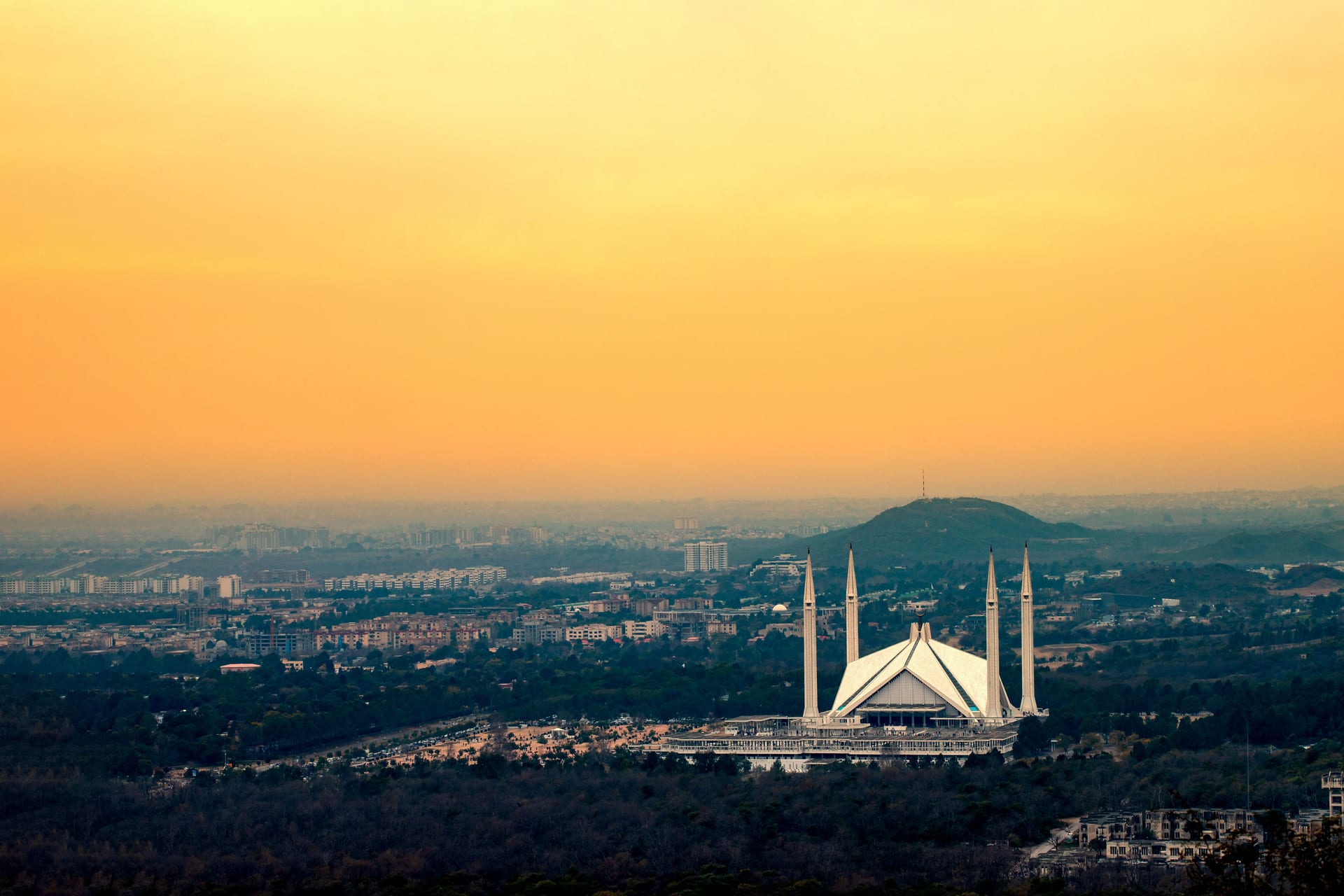
67/100Islamabad is the subcontinent's cleanest city — planned, green and orderly in a way its neighbours aren't. The wide boulevards and Faisal Mosque grounds impress, though it's car-centric and short on intimate squares. Life is cheap, with parks and the Margalla Hills close by, but it's quiet and light on events.
Safety
60/100Day-to-day crime is low, noticeably so against Karachi, and violent incidents are rare for the region. The serious caveat is political stability, which scores at the floor here: Pakistan carries real volatility, and the capital sees periodic protests, security alerts and abrupt disruptions.
Healthcare
45/100Private hospitals in the capital are among the country's better options and English is widely spoken in clinics, but the overall picture is modest. Doctors per resident are scarce, emergency care is unreliable, and serious or specialist treatment often means traveling abroad. Out-of-pocket costs stay low, which softens the gap somewhat.
Family life
48/100A gentler place to raise children than most large Pakistani cities, with open space, playgrounds and an outdoor childhood within reach of the hills. Childcare is affordable and child safety is reasonable. Schools are mid-tier, formal parental leave is minimal, and the broader work-life culture leans demanding.
Career
50/100The local market is thin, with limited industry depth and professional networks. Typical local pay is low in the wider comparison, and English-language work is available but limited. Remote work is a weak fallback, so the city suits a specific role more than an open-ended search.
Culture & food
46/100Pakistani food is the real draw, with strong local cooking and a serviceable cafe scene, though the restaurant range trails livelier Karachi and the regional heavyweights. Nightlife is essentially absent in this socially conservative city, and the music, arts and museum offerings are limited. An expat and diplomatic presence adds a little international texture.
Ease of integration
63/100Urdu is the lingua franca and English goes a long way, especially among the educated and professional classes, so newcomers can get by without learning the local language fast. Residents are reasonably welcoming to foreigners. That said, this is a traditional, religiously framed society, and cultural adjustment for outsiders is a genuine effort.
Connectivity
32/100A mixed bag that leans weak. Traffic flows better than the gridlock of Karachi and the roads are good, but public transport is sparse, cycling barely exists, and internet speeds are very slow by international standards. Power and utility reliability cannot be taken for granted. The airport gives reasonable international links.
Social values
traditionalAmong the most conservative settings here. Public life is religiously framed, social liberalism is low, and gender norms are traditional. LGBTQ acceptance is effectively nonexistent and protections do not exist. Public order and civic trust are relatively good, and there is moderate openness to foreigners, but progressive newcomers should expect a real values gap.
Relocation ease
39/100A demanding move on the paperwork front. Visas and work authorization are hard to secure, bureaucracy is heavy and slow, and banking and tax admin take patience. The upside is language: English smooths much of the daily friction. Cultural adjustment is substantial, so settling in takes time and a thick skin.
The trade-offs
A year in Islamabad
Jun peaks around 36°C, Jan days top out near 15°C, and the year brings roughly 247 bright days.
Can you actually move here?
The hard limits people most often bring to a move, scored against Islamabad's data.
Moving with a pet
Bringing a pet is moderately involved. Pakistan requires vaccination records and import permits, and processes can be slow and inconsistent, but it is manageable with advance preparation and a good relocation agent.
Who Islamabad works for
Answer the questionnaire and see where Islamabad lands for you.
Take the free questionnaireWhere else to look
Islamabad vs. comparable cities


The cities people weigh against Islamabad
Unexpected siblings
Far from Islamabad on the map, close across all 14 categories of daily life.