
Living in Bengaluru
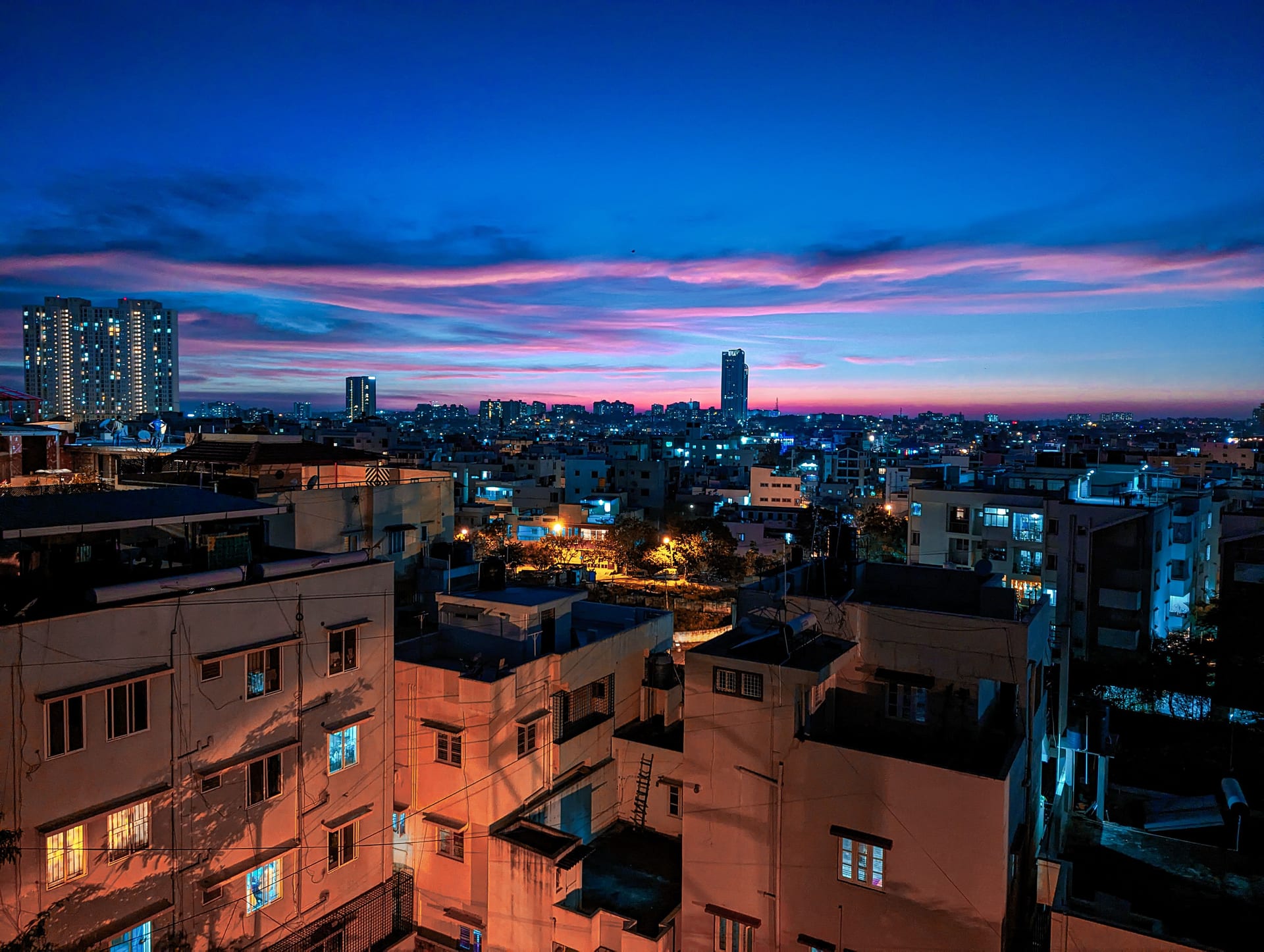
India's tech capital sits on the Deccan plateau, trading the coastal heat of Mumbai and Chennai for a mild, breezy climate and a sprawl of glass office parks. Living is remarkably cheap and the engineering scene is the densest in the country, but the traffic and patchy public services test everyone's patience.
Bengaluru at a glance
Vital stats
Shown in USD: the local currency (INR) moves too fast for stable monthly figures.
Where Bengaluru stands out
The metrics where Bengaluru sits farthest from the middle worldwide, good and bad.
Cheap to arrive, expensive to stay?
A typical one-bedroom in Bengaluru runs $217/mo. That is ~81% of one typical local employee’s mean net pay. This is a solo-newcomer stress test: sitting tenants, shared homes, subsidised housing and informal rents are deliberately outside the numerator.
The fastest way to test a shortlist is to go. A week on the ground tells you things no ranking can.
Partner link
Approved language-learning and international money resources for practical next steps.
Daily life in Bengaluru
How Bengaluru scores
Category by category
Affordability
77/100Bengaluru's open-market one-bedroom rent on a new lease is about $217 per month. That is roughly 81% of one typical employee's mean net pay, a rent burden labelled solo unlikely.
Climate
tropicalBengaluru's climate stays moderate through the year, avoiding brutal heat and cold. Seasonal darkness is minimal, but muggy weather is common and wet-grey conditions are a regular feature. Air quality is the harder trade-off, while bright weather is less consistent than the mild temperatures might suggest.
Nature access
leafyOnce known as the garden city, Bengaluru still holds large parks and a string of lakes, though green space per resident is thin against the built-up sprawl. Weekends open up the surrounding plateau, with hills, forest, and national parks within driving reach. The coast is far, so beach trips mean a real journey rather than an afternoon.
Urban form
megacityThis is a low-rise city that grew outward fast and without much plan, so walkability is poor and most errands assume a car or scooter. Neighbourhoods vary wildly block to block, and the pace runs busy without the relentless intensity of Mumbai. Mixed-use pockets exist, but stitched-together sprawl is the dominant texture.
Public life & spaces
30/100Bengaluru's tech money hasn't reached the streets: litter, garbage piles and traffic grime are everywhere, and quality public space is thin beyond Cubbon Park and a car-choked MG Road. What it has is cheap, busy daily life — markets, gigs and events run constantly, though prices sit above the rest of India.
Safety
48/100Violent crime is low and the city feels safe by the standards of large metros, with homicide rates that hold up well. Petty theft and street-level wariness after dark are the everyday concerns rather than serious danger. The larger uncertainty is political: national-level stability scores poorly, which colours the longer-term picture more than daily life on the ground.
Healthcare
49/100Private hospitals are solid and many staff speak English fluently, which smooths things for newcomers used to navigating care in their own language. The strain shows in availability: doctors are stretched thin relative to the population, and public emergency care can be unreliable. Those who can pay for private cover generally find good treatment without the bills of Western systems.
Family life
38/100Childcare is cheap and easy to arrange, and a large expat-friendly layer means international families find footholds. Schools and playground access are mixed rather than strong, and the work culture leans toward long hours, so family time competes with a demanding professional norm. Outdoor childhood is possible but shaped by traffic and limited safe public space.
Career
81/100For technology and engineering, Bengaluru offers a deep market with strong professional networks, English-language roles, and a substantial startup base. The sharp trade-off is local pay, which remains low, so access to opportunity is much stronger than the pay packet.
Culture & food
78/100Food is the standout, with one of the best vegetarian and vegan scenes anywhere, alongside strong cafes and a restaurant culture that spans regional Indian cooking and global imports. Nightlife and live music are lively for India, and a steady international crowd keeps the social mix open. Museums and formal high culture are thinner than the eating and going-out scene.
Ease of integration
70/100Kannada is the local language, but English is widely spoken across professional and social life, and Hindi adds another bridge, so newcomers rarely hit a wall in daily dealings. The city's openness to foreigners and its large transplant population make casual connections easy to form. Deeper integration into local Kannada-speaking circles takes more effort than the surface ease suggests.
Connectivity
37/100Infrastructure is the city's weakest link. Traffic congestion is legendary, public transport lags the city's growth despite an expanding metro, and utilities and digital services run less reliably than the tech reputation implies. The airport connects well internationally. Anyone moving here plans around gridlock and the occasional power or water interruption as facts of life.
Social values
mixedBengaluru reads as one of India's more cosmopolitan and outward-looking cities, comfortable with foreigners and a diverse internal mix. On gender equality, secular public life, and broader social liberalism it sits in the middle ground, more progressive than much of the country but still bound by traditional norms. Civic order and everyday trust in institutions feel loose.
Relocation ease
40/100English eases Bengaluru's arrival, but settling in is paperwork-heavy. Work authorization, tax and banking take patience, while the language barrier is comparatively light and housing search is manageable. Cultural adjustment is real, so newcomers should expect a workable landing with a demanding administrative tail.
The trade-offs
A year in Bengaluru
Apr peaks around 33°C, Nov days top out near 27°C, and the year brings roughly 157 bright days.
Can you actually move here?
The hard limits people most often bring to a move, scored against Bengaluru's data.
Moving with a pet
Bringing a pet is moderately manageable. India has formal import rules on vaccination and paperwork that need lining up in advance, and the process rewards early preparation, but it is a well-trodden path for the city's many international arrivals.
Who Bengaluru works for
Answer the questionnaire and see where Bengaluru lands for you.
Take the free questionnaireWhere else to look
Bengaluru vs. comparable cities
Objective scores (0–100) for Bengaluru and its 4 nearest comparable cities.
The cities people weigh against Bengaluru
Unexpected siblings
Far from Bengaluru on the map, close across all 14 categories of daily life.