
Living in Ho Chi Minh City
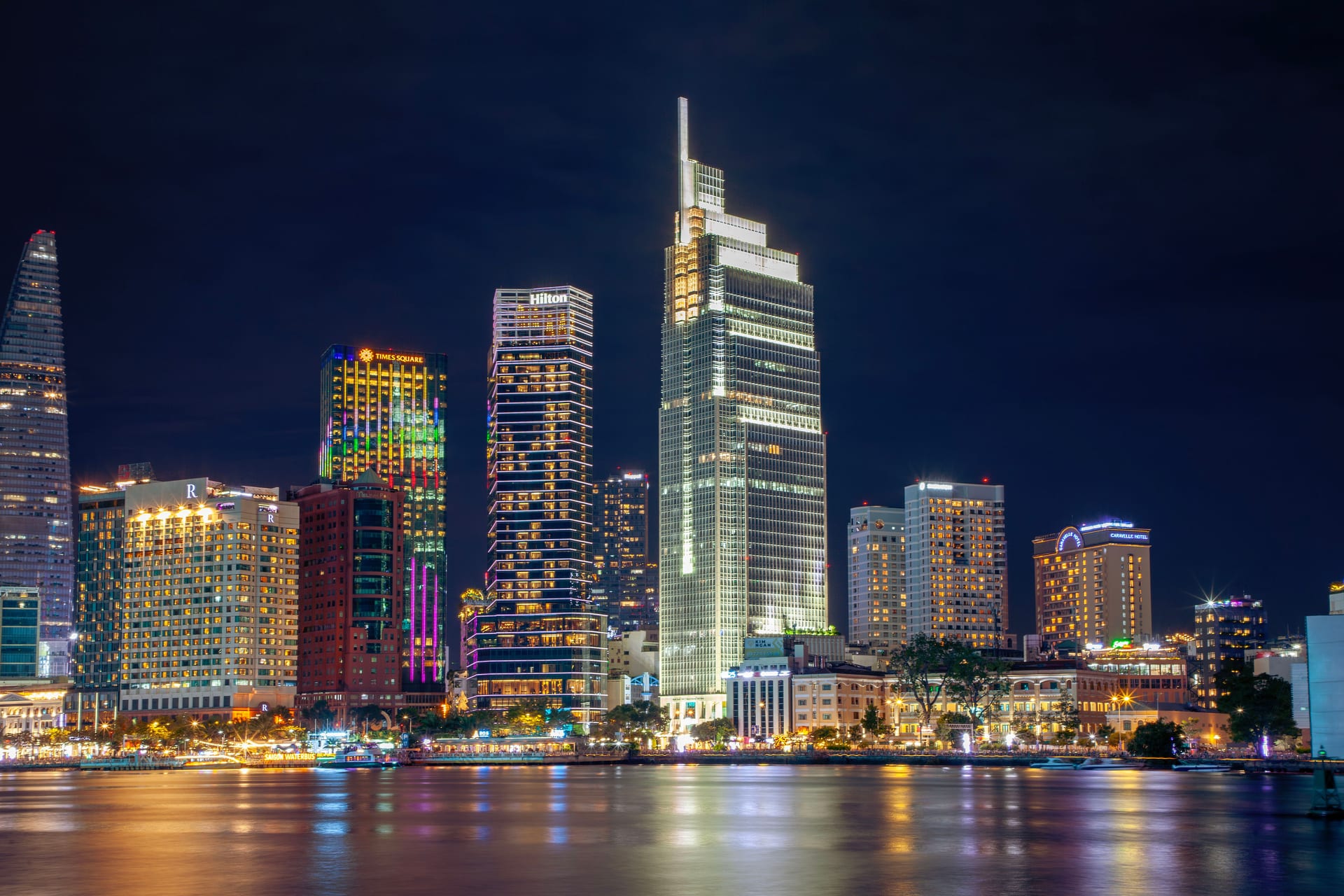
Vietnam's commercial engine runs hot, loud, and cheap, a sprawl of scooters, street kitchens, and coffee culture that rarely slows down. Day-to-day costs sit well under Bangkok or Tokyo, and the energy is closer to Bangkok's than to anywhere calmer. What it asks in return is tolerance for heat, traffic, and a steep language gap.
Ho Chi Minh City at a glance
Vital stats
Shown in USD: the local currency (VND) moves too fast for stable monthly figures.
Where Ho Chi Minh City stands out
The metrics where Ho Chi Minh City sits farthest from the middle worldwide, good and bad.
Cheap to arrive, expensive to stay?
A typical one-bedroom in Ho Chi Minh City runs $360/mo. That is ~111% of one typical local employee’s mean net pay. That is 12 points above Phnom Penh, its closest rival among nearby cities. This is a solo-newcomer stress test: sitting tenants, shared homes, subsidised housing and informal rents are deliberately outside the numerator.
The fastest way to test a shortlist is to go. A week on the ground tells you things no ranking can.
Partner link
Approved language-learning and international money resources for practical next steps.
Daily life in Ho Chi Minh City
How Ho Chi Minh City scores
Category by category
Affordability
72/100Ho Chi Minh City's open-market one-bedroom rent on a new lease is about $360 per month. That is roughly 111% of one typical employee's mean net pay, a rent burden labelled solo unlikely.
Climate
tropicalThere is no cool season in Ho Chi Minh City, and muggy conditions occur on roughly 365 days a year. The long wet season makes for many grey, rainy stretches, while only about 113 days are bright. Air quality is another clear weakness, so the climate is more relentless than restful.
Nature access
urbanGreen space is the city's weakest hand. Parks are few and small, and there is very little public greenery per resident, less even than most regional peers. Mountains, forests, and real hiking all sit at a distance rather than on the doorstep. Weekend escapes to the coast or countryside exist, but the city itself offers little room to breathe.
Urban form
megacityA dense, fast, scooter-driven sprawl built around motorbikes rather than feet. Walkability is poor and crossing the street takes nerve, with car and bike dependency far higher than in Tokyo or Singapore. The pace is relentless, busier than Bangkok or Manila, and the streetscape mixes shops, homes, and food stalls together in a way that keeps the city alive at all hours.
Public life & spaces
44/100Ho Chi Minh City is dense, humid and chaotic, its motorbike-choked streets grimy and its walkable squares few beyond a handful of colonial boulevards near the cathedral. The trade is energy for free: street food, Ben Thanh market and pavement life everywhere, all cheap. You come for the buzz, not for clean, restful public space.
Safety
60/100Serious violent crime is rare and the homicide rate is low, lower than Bangkok or Manila, so most residents feel at ease day to day. Petty theft and bag-snatching are the real nuisance, roughly on par with the region. The genuine danger is the roads: traffic safety is poor, among the weaker records anywhere, and the chaotic scooter traffic is the thing newcomers underestimate most.
Healthcare
48/100Healthcare is functional rather than reassuring. Public hospitals are stretched and doctors are thin on the ground, so many expats and wealthier locals lean on private international clinics for anything serious. Quality and emergency reliability land in the middle of the regional pack, similar to Manila and below Bangkok. English-speaking care is available but not a given.
Family life
40/100A workable but unpolished place to raise children. Childcare is affordable and reasonably available, and the work-life rhythm is gentler than Tokyo or Singapore. School quality, playgrounds, and family-friendly green space are all middling, leaning on private international schools for the upper end. Child safety is fine by regional standards, though the traffic remains a constant background worry.
Career
69/100An active local market and very low unemployment are offset by local pay that is low by the wider benchmark. English-first roles are scarce. Remote work is the clearer advantage, giving people who earn abroad more room than the local pay scale does.
Culture & food
79/100This is where the city shines. The food scene is deep and cheap, the cafe culture is exceptional and woven into daily life, and nightlife holds its own against Bangkok. Local culture is vivid and confidently its own, and a growing international crowd has settled in. Museums and the formal arts are thinner, more on par with Bangkok than a global cultural capital.
Ease of integration
70/100Vietnamese is the language of daily life and English only goes so far outside expat circles, so meaningful local friendships take real effort and some study. That said, the city is genuinely open to foreigners, more so than Tokyo, and an established international community gives newcomers a soft landing. Integrating deeply is slow; finding your feet socially is not.
Connectivity
35/100Mixed and improving. Mobile and home internet are fast and dependable, a real strength, but public transport is sparse and a long-planned metro is only beginning to arrive. Cycling infrastructure is close to nonexistent and congestion is heavy. The airport connects well across Asia, while intercity rail lags behind Bangkok and most of the region.
Social values
mixedSocially middle-of-the-road and quietly secular in public life. Attitudes toward gender and LGBTQ life are more relaxed than in much of the region, ahead of Tokyo or Manila on several counts, though still short of Bangkok or a liberal European capital. Society skews practical and traditional under the surface, and civic orderliness is loose rather than rule-bound.
Relocation ease
44/100Settling in is a mixed bag. Finding a flat is refreshingly quick and informal, easier than Tokyo or Berlin, but visas, work permits, banking, and paperwork are slow and opaque. The language barrier is steep, on par with Bangkok, and bureaucracy demands patience. Cultural adjustment itself is gentler than the admin would suggest.
The trade-offs
A year in Ho Chi Minh City
Apr peaks around 34°C, Jan days top out near 31°C, and the year brings roughly 113 bright days.
Can you actually move here?
The hard limits people most often bring to a move, scored against Ho Chi Minh City's data.
Moving with a pet
Bringing a pet is moderately manageable, easier than into much of Europe but with real paperwork. Expect import permits, vaccination records, and a health certificate, and budget time for the process rather than assuming it will be quick.
Who Ho Chi Minh City works for
Answer the questionnaire and see where Ho Chi Minh City lands for you.
Take the free questionnaireWhere else to look
Ho Chi Minh City vs. comparable cities


Objective scores (0–100) for Ho Chi Minh City and its 4 nearest comparable cities.
The cities people weigh against Ho Chi Minh City
Unexpected siblings
Far from Ho Chi Minh City on the map, close across all 14 categories of daily life.
