
Living in La Paz
The de facto seat of Bolivia's government sits in a bowl high in the Andes, the highest big city in Latin America and one of the cheapest places to live on the continent. Daily life is steep, informal, and deeply tied to indigenous Aymara culture. The thin air, weak job market, and patchy infrastructure ask a lot of newcomers.
La Paz at a glance
Vital stats
Shown in USD: the local currency (BOB) moves too fast for stable monthly figures.
Where La Paz stands out
The metrics where La Paz sits farthest from the middle worldwide, good and bad.
Cheap to arrive, expensive to stay?
A typical one-bedroom in La Paz runs $293/mo. That is ~74% of one typical local employee’s mean net pay. This is a solo-newcomer stress test: sitting tenants, shared homes, subsidised housing and informal rents are deliberately outside the numerator.
The fastest way to test a shortlist is to go. A week on the ground tells you things no ranking can.
Partner link
Approved language-learning and international money resources for practical next steps.
Daily life in La Paz
How La Paz scores
Category by category
Affordability
77/100La Paz's open-market one-bedroom rent on a new lease is about $293 per month. That is roughly 74% of one typical employee's mean net pay, a rent burden labelled sharing likely.
Climate
coldLa Paz stays cool rather than hot, and muggy weather is effectively absent in its dry air. The sky is mixed, with 160 bright days and 114 grey, rainy days. The main adjustment is cool weather rather than seasonal heat, so the city suits people who prefer crisp conditions to tropical warmth.
Nature access
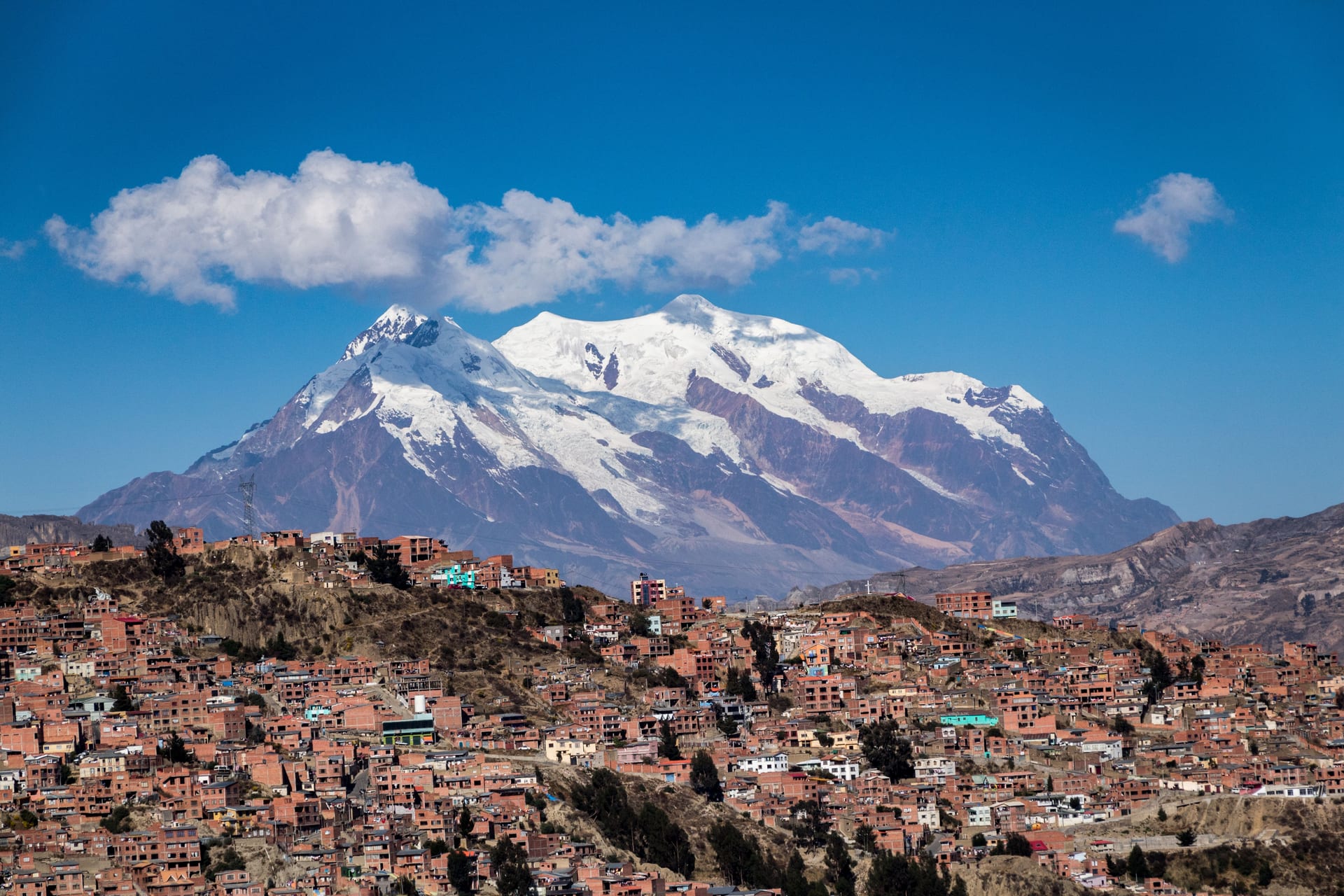
alpineThis is the city's strongest card. La Paz sits beneath the snow line of the Cordillera Real, with world-class hiking, peaks, and high-altitude trekking essentially on the doorstep, plus Lake Titicaca and the altiplano within easy weekend reach. What it cannot offer is the coast, since Bolivia is landlocked, and green space inside the dense urban bowl is thin.
Urban form
large cityBuilt into a canyon, La Paz climbs and drops in ways few cities do, knitted together by an extensive cable-car network that doubles as transit. It is a mid-sized capital rather than a sprawling metropolis, with walkable older quarters but punishingly steep gradients that make getting around on foot hard work. Land use mixes housing and commerce closely.
Public life & spaces
44/100La Paz is dense and chaotic, its upkeep uneven, its market streets always busy. The plazas and the cable-car views give it real public life, lively if cramped on its steep slopes. Living is very cheap, and the pleasures that count, festivals and the teeming street markets, are free and run through everyday life.
Safety
49/100A mixed picture. Serious violent crime is comparatively low for the region, and far below the levels that trouble much of Latin America. But petty theft, pickpocketing, and caution after dark are real day-to-day concerns, and Bolivia's politics have a history of protests, blockades, and abrupt instability that can disrupt the city for days.
Healthcare
36/100Healthcare is one of the weaker areas. Doctors and reliable emergency care are in short supply, and public facilities are stretched, though out-of-pocket costs are modest by international standards. Serious or complex treatment often means travelling to a larger private centre or abroad, and English-speaking medical staff are uncommon.
Family life
36/100A modest setting for raising children. Schooling, childcare options, and family-friendly housing are limited, and parks and playgrounds within the steep urban core are sparse. The upside is a culture where children are folded easily into public life and the mountains offer plenty of room to roam, but day-to-day family logistics take effort.
Career
40/100The local career base is narrow, with limited English-language roles, a small startup scene, and a thin professional network. Local pay is low, but unemployment is low. Remote work is only a middling option, so the city suits people who can tolerate a constrained local market more than those seeking broad career choice.
Culture & food
64/100The real depth is local rather than cosmopolitan. Aymara and Andean traditions run through the markets, festivals, and street life in a way few capitals can match, and the museum and music scenes hold their own. International dining, vegetarian options, and a large expat community are limited, so the pull here is immersion in something genuinely distinct.
Ease of integration
56/100Spanish is essential, since English goes only so far and Aymara and Quechua are woven into daily life. Locals are reasonably warm toward outsiders, but the city is socially conservative and not especially international, so building a circle rewards real effort and language. Newcomers who lean into the culture tend to be welcomed; those expecting an expat bubble will struggle.
Connectivity
25/100Outside the standout cable-car system, infrastructure lags. Bolivia has effectively no passenger rail, the airport offers limited international links, and digital infrastructure and online bureaucracy are well behind regional peers. Utilities and roads are serviceable but inconsistent, and anyone reliant on fast, dependable connectivity should plan around the gaps.
Social values
mixedSocially, La Paz is on the traditional and conservative side. Secular public culture, social liberalism, LGBTQ acceptance, and gender equality all score low, and civic trust in institutions is fragile. There is genuine openness to foreigners as visitors, but the broader value system is rooted and unhurried, more conservative than the region's larger, more liberal capitals.
Relocation ease
44/100Settling in is mid-difficulty. Residence and work permits are achievable and finding housing is relatively straightforward, but bureaucracy is slow, paperwork is paper-based, and banking and admin can be frustrating. The Spanish-language environment and a real cultural adjustment, altitude included, mean the move suits the patient and adaptable more than the time-pressed.
The trade-offs
A year in La Paz
Nov peaks around 17°C, Jan days top out near 14°C, and the year brings roughly 160 bright days.
Can you actually move here?
The hard limits people most often bring to a move, scored against La Paz's data.
Moving with a pet
Bringing a pet is comparatively manageable here, with import requirements that are moderate rather than onerous. Expect to organise vaccinations and health paperwork in advance, and to navigate the process largely in Spanish.
Who La Paz works for
Answer the questionnaire and see where La Paz lands for you.
Take the free questionnaireWhere else to look
La Paz vs. comparable cities


The cities people weigh against La Paz
Unexpected siblings
Far from La Paz on the map, close across all 14 categories of daily life.

