
Living in Amman
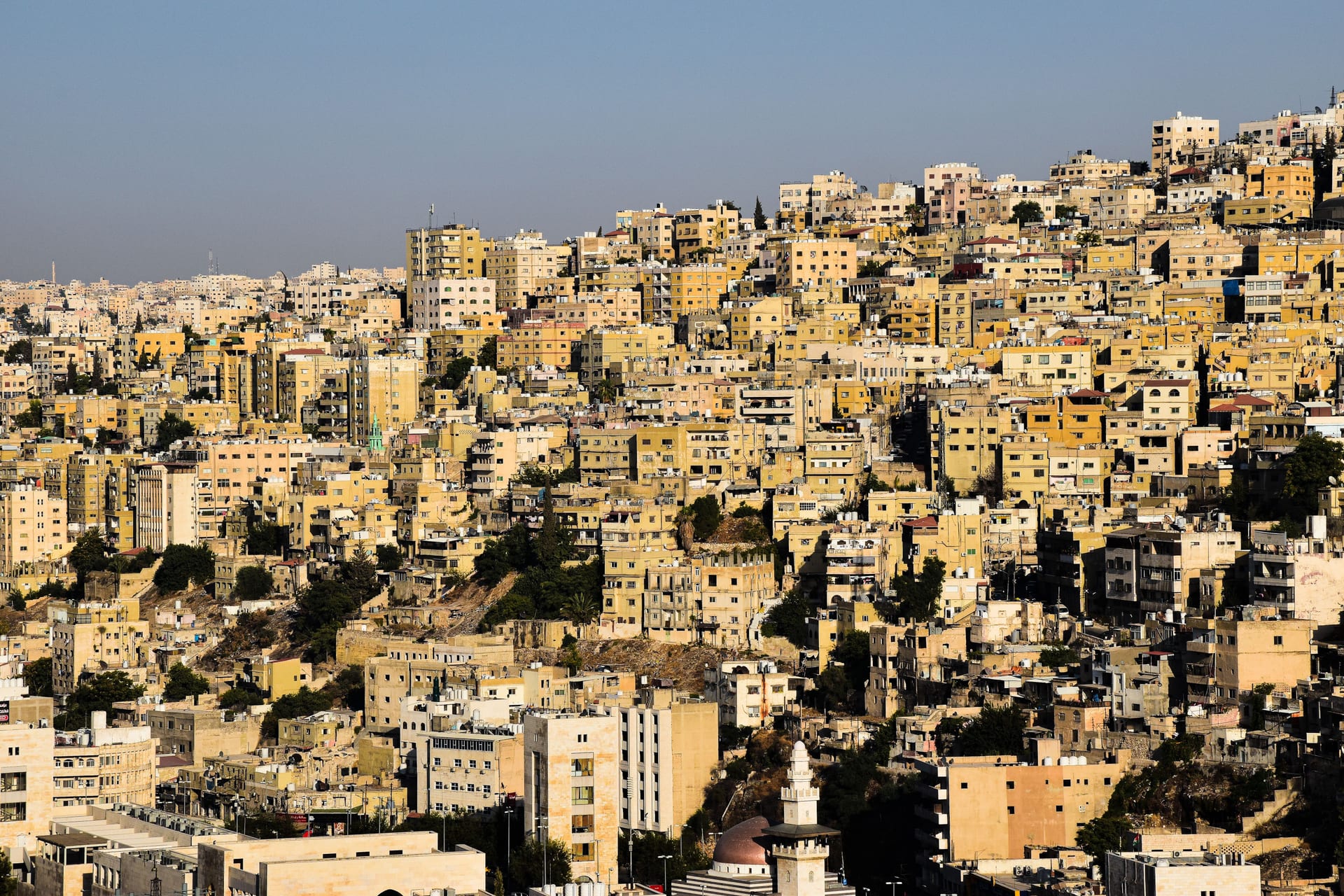
Jordan's hilltop capital is calm, conservative, and one of the most affordable cities in the region, far cheaper than Tel Aviv or the Gulf hubs. Life here is unhurried and family-centred, built around home and hospitality rather than scenes and nightlife. The trade-off is a thin job market and a heavy reliance on cars.
Amman at a glance
Vital stats
Shown in USD: the local currency (JOD) moves too fast for stable monthly figures.
Where Amman stands out
The metrics where Amman sits farthest from the middle worldwide, good and bad.
Cheap to arrive, expensive to stay?
A typical one-bedroom in Amman runs $337/mo. That is ~74% of one typical local employee’s mean net pay. That is 12 points above Kuwait City, its closest rival among nearby cities. This is a solo-newcomer stress test: sitting tenants, shared homes, subsidised housing and informal rents are deliberately outside the numerator.
The fastest way to test a shortlist is to go. A week on the ground tells you things no ranking can.
Partner link
Approved language-learning and international money resources for practical next steps.
Daily life in Amman
How Amman scores
Category by category
Affordability
73/100Amman's open-market one-bedroom rent on a new lease is about $337 per month. That is roughly 74% of one typical employee's mean net pay, a rent burden labelled sharing likely.
Climate
mediterraneanAmman has a bright, dry rhythm, with roughly 318 bright days in a year and only short grey spells. Summers are warm rather than oppressive, while winters can be genuinely cold, with January averaging about 9°C. The dry air keeps muggy weather rare, though air quality is a weak point.
Nature access
wildGreen space is the weak spot here. The city itself is short on parks and has no coastline, so everyday nature is limited. What saves it is the country around it: the desert, the Dead Sea, and hiking trails are all within reach for a weekend, more than most Gulf cities can offer.
Urban form
large cityAmman is a dense metropolis of roughly 6.4 million people, yet its steep terrain and disconnected layout make walking difficult. Cars still dominate daily movement, while mixed-use neighbourhoods are limited. Apartments offer a reasonable amount of space, and the overall tempo is moderate rather than frantic.
Public life & spaces
44/100Amman is dusty and uneven, its upkeep wavering across the hills, and modern plazas are scarce beyond the downtown souks and the old Roman theatre. But life is cheap and lived in the streets — the markets, the cafés, the affordable everyday culture cost almost nothing. Vibrant if you forgive the grime.
Safety
72/100Amman feels safe in ordinary street life. Violent crime and petty theft are uncommon, and walking after dark is usually comfortable, but traffic is a genuine hazard. The wider political environment adds uncertainty that is separate from day-to-day personal safety.
Healthcare
59/100Amman is a recognised medical hub in the region, drawing patients from neighbouring countries, and private care is solid with plenty of English-speaking doctors. Hospital access and emergency care are dependable. The thinner spot is overall doctor availability, so popular specialists can mean waits, and good private cover matters.
Family life
51/100Family life is at the centre of how the city works, and children are safe and welcome everywhere. International and private schools exist for those who can afford them, though public options and childcare are middling. Parental leave is limited. Kids grow up with plenty of social life and a strong sense of extended family.
Career
43/100Amman's local market is difficult to enter, with unemployment around 17% and limited professional networks. English-language roles and remote work offer some openings, but local pay is very low and industry breadth is thin. The city suits people with an existing income path better than newcomers counting on rapid local career progression.
Culture & food
58/100Food is where Amman shines, from legendary street eats to a growing café culture, and the city holds onto a genuine local character that Gulf cities have largely traded away. There is an established international and NGO crowd, decent museums and a quiet arts scene. Nightlife is modest, in keeping with a fairly conservative city.
Ease of integration
67/100Arabic is the language of daily life, but English goes a long way in Amman, especially among younger and educated residents, which softens the landing for newcomers. Jordanians are known for warmth and hospitality, and the city is used to outsiders. Real integration still takes effort and patience with a culture built around family circles.
Connectivity
32/100Infrastructure is where Amman lags. Public transport is minimal and unreliable, there is effectively no rail, and cycling is unrealistic on the hills and traffic, so a car is close to mandatory. Internet is decent and utilities generally hold up. The airport keeps the city well connected internationally.
Social values
traditionalAmman is socially conservative and religion is woven through public life, more so than secular Tel Aviv though broadly in step with the wider region. LGBTQ acceptance is low and gender norms remain traditional. The redeeming quality is a real, well-earned openness to foreigners, who tend to be received with curiosity and warmth.
Relocation ease
54/100Settling in is moderately smooth by regional standards. Residence and housing are relatively straightforward to sort out, and English smooths much of the paperwork. The friction shows up in everyday bureaucracy, which can be slow and opaque, and in adjusting to a more conservative, family-oriented rhythm of life.
The trade-offs
A year in Amman
Jul peaks around 34°C, Jan days top out near 13°C, and the year brings roughly 318 bright days.
Can you actually move here?
The hard limits people most often bring to a move, scored against Amman's data.
Moving with a pet
Bringing a pet to Amman is moderately manageable, easier than some neighbours though it takes paperwork: an import permit, vaccinations, and health certificates arranged ahead of arrival. Cats and dogs are far more common in homes than on the streets.
Who Amman works for
Answer the questionnaire and see where Amman lands for you.
Take the free questionnaireWhere else to look
Amman vs. comparable cities


Objective scores (0–100) for Amman and its 4 nearest comparable cities.
The cities people weigh against Amman
Unexpected siblings
Far from Amman on the map, close across all 14 categories of daily life.

