Affordability
78/100Jeddah's open-market one-bedroom rent on a new lease is about $758 per month. That is roughly 41% of one typical employee's mean net pay, a rent burden labelled tight alone.
Climate
dry heatJeddah has an exceptionally bright, rain-light climate, with roughly 346 bright days and only about a week of rainy-grey weather. Winter is warm and comfortable, but summer averages around 33°C and muggy conditions last through most of the year. Heat and air quality are the real costs of that reliable light.
Nature access
coastalSet against the desert, Jeddah is short on green. There are no forests, no rivers or lakes, and parks within the city are sparse, so anyone craving woodland or open countryside will feel the gap. The redeeming feature is the coast: Red Sea beaches and some of the world's best diving and snorkelling are close at hand.
Urban form
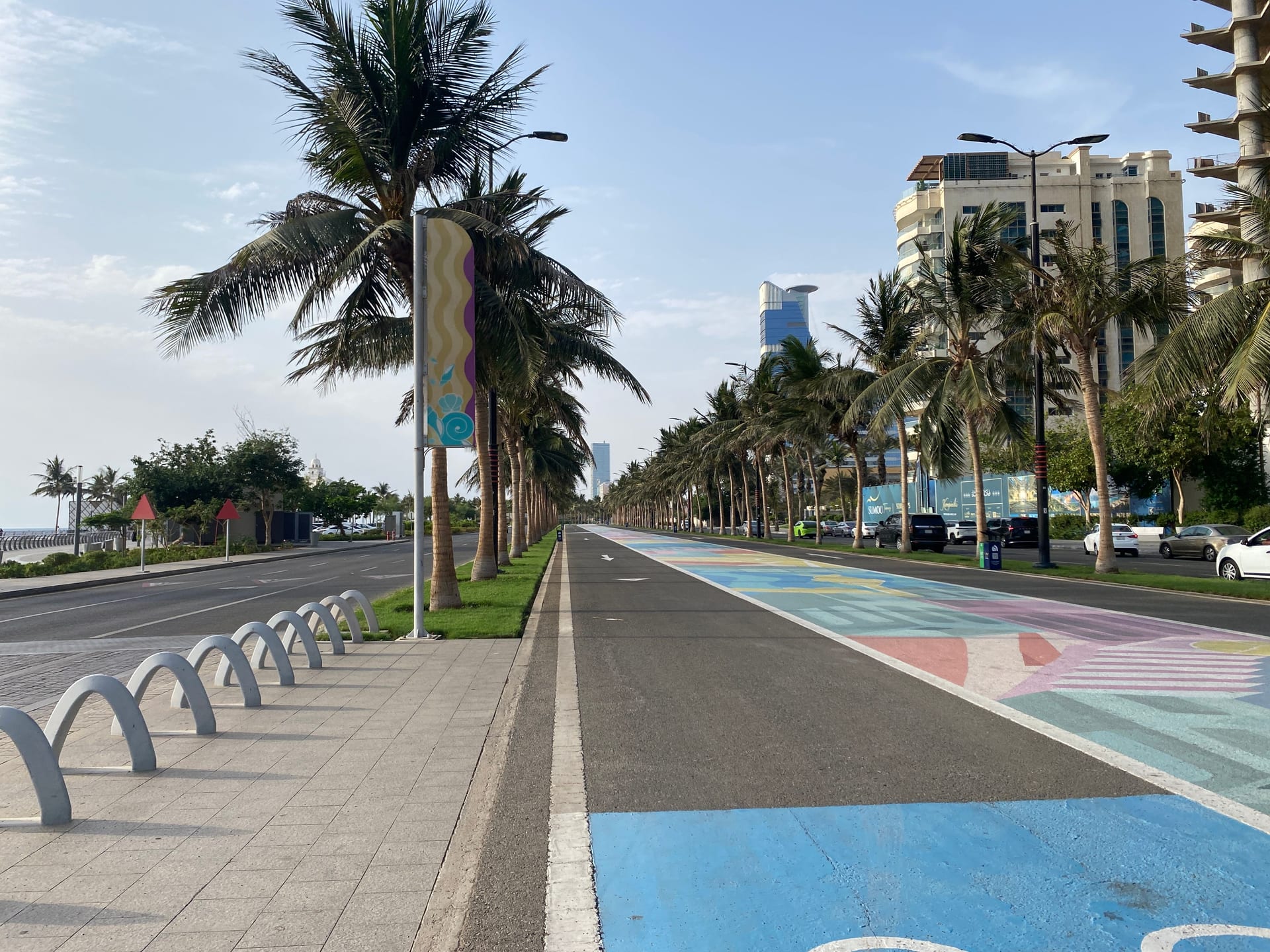
large cityA sprawling, car-built city where walking rarely makes sense and distances are covered by driving. Density is low and neighbourhoods spread wide rather than cluster, so the compact, stroll-everywhere texture of an older European or Asian city is absent here. The Corniche is a notable exception, a long seafront stretch people actually walk for pleasure.
Public life & spaces
56/100Jeddah carries Gulf wealth but wears it less evenly — the denser, older quarters pick up grime the showcase districts don't. The Corniche waterfront is genuinely strong, and Al-Balad's historic core gives the city texture. The free seafront helps, but otherwise daily life runs to expensive Gulf prices.
Safety
73/100Very safe by most everyday measures, with low violent and petty crime and a strong sense of personal security on the streets, day or night. This is a real and widely felt strength. The caveat sits at the political level, where the wider regional context carries more uncertainty than the calm of daily life would suggest.
Healthcare
65/100Hospital access is solid and English is commonly spoken in private clinics, which eases things considerably for newcomers. Overall medical quality is decent if not top-tier. Doctor availability is thinner than ideal, and navigating insurance and out-of-pocket costs takes some figuring out, so it pays to understand the system before relying on it.
Family life
49/100Children are safe here and the city is calm, which counts for a lot. Beyond that the picture is mixed: international schools exist but childcare is costly and limited, family-sized housing is not always easy to secure, and parks and playgrounds are scarce. The long, fierce summers also keep outdoor childhood indoors for much of the year.
Career
61/100Jeddah's local market is reasonably broad, with English useful in many workplaces and unemployment relatively low. Typical local pay sits near the middle of the comparison. Startup and remote-work options are thinner, so opportunity still depends heavily on sector and employer.
Culture & food
47/100A long-standing merchant port, Jeddah is the more open and outward-looking of the kingdom's big cities, with a steady international crowd and a strong food culture spanning regional and global kitchens. Cafés and restaurants are plentiful. Nightlife in the Western sense effectively does not exist, since alcohol is banned and entertainment runs along very different lines.
Ease of integration
67/100Arabic is the language of daily life, and while English goes a long way in business and expat circles, settling in properly is helped by some Arabic and a willingness to adapt. The large international population makes it straightforward to find a foreign community. Integrating into local Saudi life is a slower path, shaped by conservative customs and a relatively closed social world.
Connectivity
47/100Reliable utilities and an extremely well-connected airport are the strong points, and dealing with bureaucracy has become noticeably more digital. Public transport, though, is barely a factor and cycling infrastructure is minimal, so a car is close to essential. Digital connectivity is serviceable rather than excellent, and traffic can be heavy.
Social values
traditionalThis is where many newcomers feel the biggest adjustment. Public life is shaped by religious and traditional norms, with no secular nightlife culture, conservative expectations around dress and behaviour, and limited social liberalism. Gender norms and the legal climate for LGBTQ people are restrictive. Reforms have loosened things in recent years, but the baseline remains markedly conservative.
Relocation ease
58/100Moving here is manageable but demands cultural flexibility above all. Visa and work-authorization routes are workable, tax paperwork is simple given there is no income tax, and banking and housing searches are reasonable. The real hurdle is cultural adjustment: the social rules differ sharply from Western norms, and that is the part most arrivals underestimate.