
Living in Graz
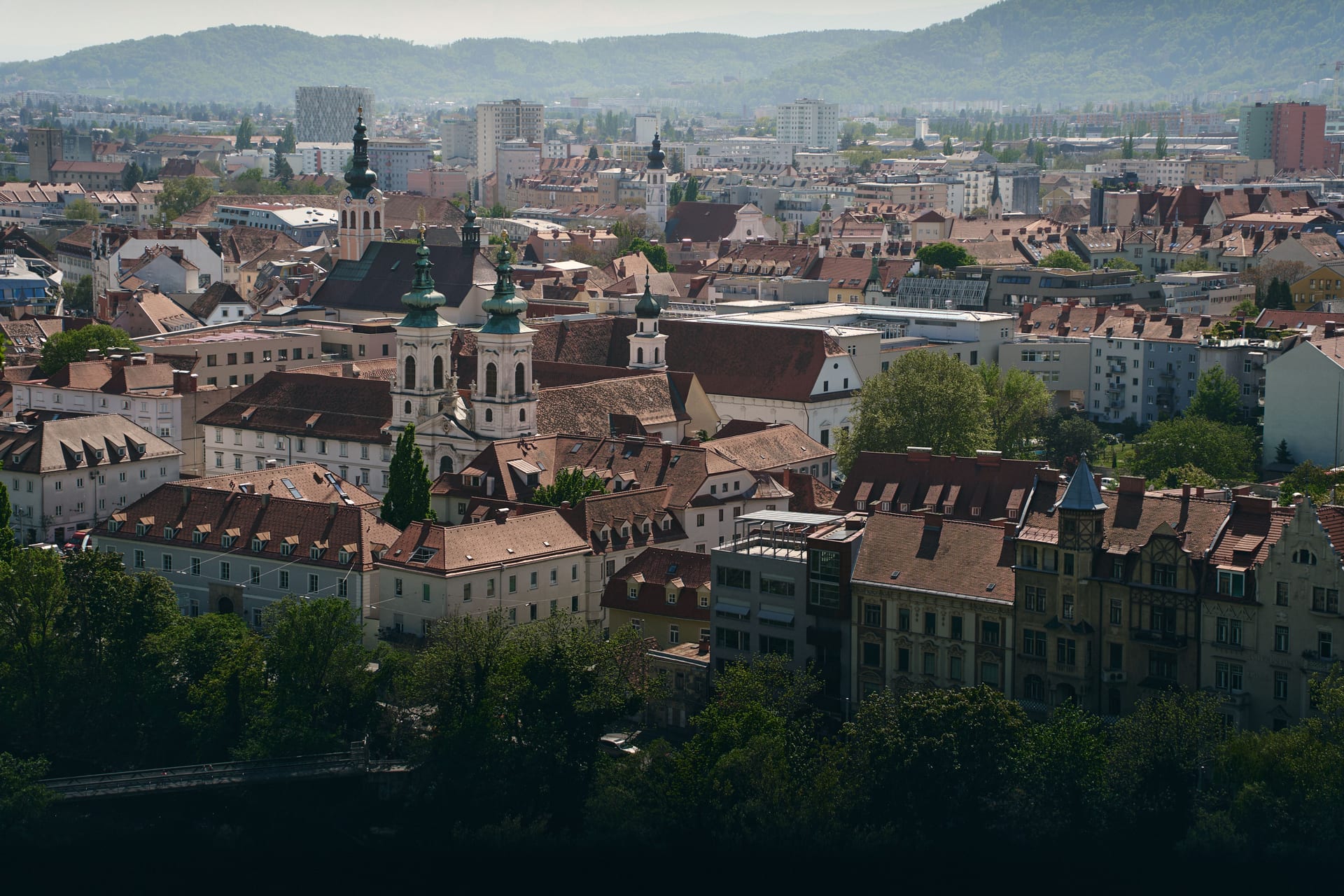
Austria's second city is a calm, student-flecked university town in the southeastern hills, cheaper and slower than Vienna without feeling provincial. Daily life leans walkable and safe, with Alpine country an easy weekend away. The trade-off is a smaller job market and a German-speaking rhythm that newcomers eventually have to meet.
Graz at a glance
Vital stats
Where Graz stands out
The metrics where Graz sits farthest from the middle worldwide, good and bad.
Cheap to arrive, expensive to stay?
A typical one-bedroom in Graz runs €627/mo. That is ~21% of one typical local employee’s mean net pay. This is a solo-newcomer stress test: sitting tenants, shared homes, subsidised housing and informal rents are deliberately outside the numerator.
The fastest way to test a shortlist is to go. A week on the ground tells you things no ranking can.
Partner link
Approved language-learning and international money resources for practical next steps.
Daily life in Graz
How Graz scores
Category by category
Affordability
69/100Graz's open-market one-bedroom rent on a new lease is about €627 per month. That is roughly 21% of one typical employee's mean net pay, a rent burden labelled manageable solo.
Climate
temperateWinters are cold and summers mild. Around 197 bright days give the year a more open feel, and rainy-grey days stay below a hundred. Muggy conditions remain limited, but winter still carries a noticeable dimness.
Nature access
forestedThis is where the city earns its keep. The Styrian hills, forests, and the edge of the Alps are all close enough for a day or a weekend, with hiking, cycling, and running routes branching straight out of town. The one clear gap is water, with no coast or major lake within easy reach, so this is mountain country, not beach country.
Urban form
mid-sizedGraz has a small-city footprint, with a metro area of about 307,000 people. A walkable, mixed-use core and low car dependence make everyday errands easy, while the quieter tempo and limited metropolitan scale will not suit someone chasing constant intensity.
Public life & spaces
78/100Graz is clean and tidy in the unfussy Austrian way, a provincial capital kept in good order. The UNESCO old town, the Schlossberg and the Hauptplatz give it handsome squares to gather in. A lively student city, it runs festivals and free events through the year, and costs sit comfortably below Vienna's.
Safety
82/100One of the safer cities a person could move to, anywhere. Violent crime is rare, petty crime is low, and walking home late registers as a non-issue for most residents. Traffic is comparatively orderly and the wider political backdrop is stable. On this axis the city is genuinely reassuring.
Healthcare
75/100Healthcare is a strong, dependable part of life here, plugged into Austria's well-funded system with good hospital access and low out-of-pocket exposure. Doctors are reasonably available and emergency care is reliable. English is workable in clinical settings, though sorting out insurance and admin can still take some patience.
Family life
79/100A reassuring place to raise children. It is very safe for kids, childcare is available and affordable, schools are solid, and the work-life culture leaves room for family time. The real edge is the outdoor childhood on offer, with parks, playgrounds, and open country all within easy reach.
Career
58/100Graz offers a workable local market, though it is not deep in English-language roles or startup work. Unemployment is higher than the corpus norm, so the fit improves for people who can work remotely. Local pay is comparatively high, even as the range of local opportunities remains limited.
Culture & food
68/100There is more going on than the size suggests, helped by a large student population and the strong local food culture of the surrounding Styrian farmland. Cafes, restaurants, museums, and a steady arts calendar all hold up well. It will not match Vienna's depth or Berlin's nightlife, but for a city this scale the cultural life is full.
Ease of integration
59/100German is the language of daily life, and while English goes a long way among the young and the university crowd, building a local circle eventually means learning it. The international community is present but modest, and the social climate is friendly without being effusive. Newcomers who make the language effort tend to integrate steadily rather than instantly.
Connectivity
66/100Getting around locally is easy, with strong cycling infrastructure, reliable utilities, and manageable traffic. The weaker links are reaching the wider world and dealing with the state. The airport is small and connections often route through Vienna, while official processes remain only partly digitised. Train links across the country are solid.
Social values
progressiveSocially the city sits in the moderate-progressive middle. Attitudes on gender, sexuality, and personal freedom are broadly liberal and civic trust runs high, but it carries a more traditional, conservative streak than Vienna or Berlin. Day to day it reads as tolerant and orderly rather than edgy or radical.
Relocation ease
58/100Moving in is middle-of-the-road in difficulty. Visas, work authorisation, and Austrian bureaucracy take effort and patience, and the language barrier is real for non-German speakers. The upside is that finding housing is noticeably less of a scramble here than in Vienna or Berlin, and the cultural adjustment for fellow Europeans is gentle.
The trade-offs
A year in Graz
Jul peaks around 27°C, Jan days top out near 4°C, and the year brings roughly 197 bright days.
Can you actually move here?
The hard limits people most often bring to a move, scored against Graz's data.
Moving with a pet
Bringing a pet is straightforward. As an EU destination with standard pet-import rules, a microchip, rabies vaccination, and a pet passport or health certificate generally cover the move, with no quarantine for animals from most countries.
Who Graz works for
Answer the questionnaire and see where Graz lands for you.
Take the free questionnaireWhere else to look
Graz vs. comparable cities

The cities people weigh against Graz
Unexpected siblings
Far from Graz on the map, close across all 14 categories of daily life.

