
Living in Vienna
Austria's capital runs on order, quiet, and a deep cultural inheritance. Life here is calmer and more buttoned-up than Berlin, the city most newcomers measure it against, with rents that come in lower and public services that simply work. The pace is unhurried, the streets are safe, and the coffeehouse is a way of life.
Vienna at a glance
Vital stats
Where Vienna stands out
The metrics where Vienna sits farthest from the middle worldwide, good and bad.
Cheap to arrive, expensive to stay?
A typical one-bedroom in Vienna runs €861/mo. That is ~27% of one typical local employee’s mean net pay. This is a solo-newcomer stress test: sitting tenants, shared homes, subsidised housing and informal rents are deliberately outside the numerator.
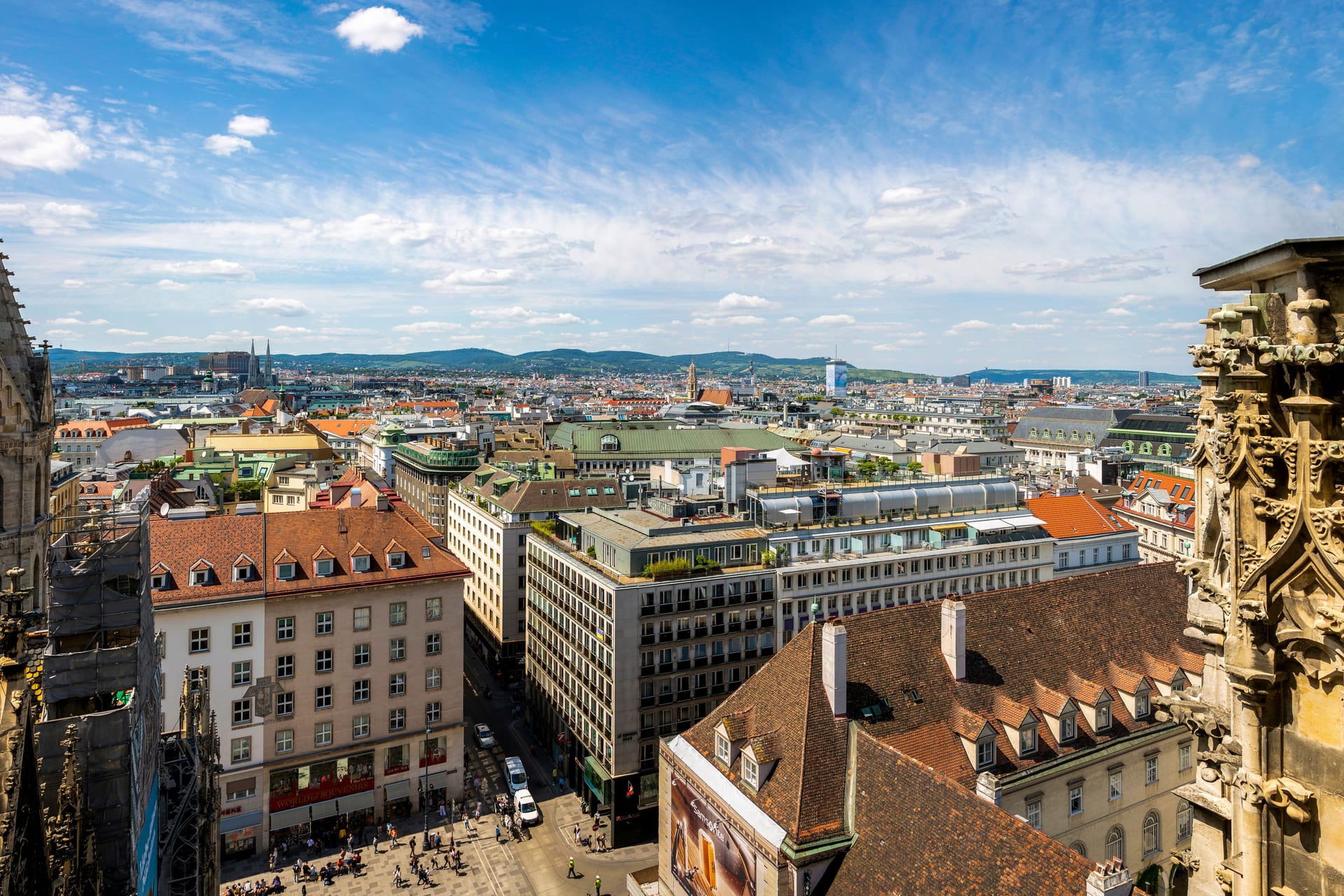
The fastest way to test a shortlist is to go. A week on the ground tells you things no ranking can.
Partner link
Approved language-learning and international money resources for practical next steps.
Daily life in Vienna
How Vienna scores
Category by category
Affordability
67/100Vienna's open-market one-bedroom rent on a new lease is about €861 per month. That is roughly 27% of one typical employee's mean net pay, a rent burden labelled manageable solo.
Climate
temperateVienna has warm summers, with July averaging about 22°C, while January stays just above freezing. The year brings 189 bright days and relatively few rainy-grey days, but summer can turn muggy. Air quality is reasonably clean and extreme weather is rare.
Nature access
leafyGreen for a city its size, with generous parks, the Vienna Woods on the doorstep, and the Danube threading through. Weekend trips to the Alps and the lake country are easy by Austrian standards, far more so than from Berlin. The one clear gap is the sea, which is a long haul away.
Urban form
large cityDense, walkable, and built for living without a car. Neighbourhoods are well-defined and mixed-use, with shops, cafes, and transit woven into daily routines. The tempo is deliberately unhurried, slower than Berlin and far from frantic, which suits some and frustrates others.
Public life & spaces
93/100Vienna is pristine and orderly, its public spaces beautifully maintained. The civic realm is superb — imperial squares, the Ringstrasse, the sprawling Prater. Culture is heavily subsidised, with free parks and seasonal events keeping daily life accessible, though overall costs land squarely mid-range rather than cheap.
Safety
84/100One of the safest big cities in Europe, full stop. Violent crime is rare, the streets feel secure after dark, and traffic is managed with care. Petty theft exists in tourist-heavy spots but stays modest. Residents move around at night without a second thought.
Healthcare
81/100A strong public system with excellent hospitals and good access to doctors. Quality matches the best German-speaking cities, and out-of-pocket costs stay low once insurance is sorted. English-speaking care is available though not guaranteed, so some German helps in a clinic.
Family life
81/100A genuinely good place to raise children. Child safety is exceptional, childcare is widely available and affordable, and the work-life culture leaves room for family time. Playgrounds and parks are plentiful. Larger family flats take some searching, but the fundamentals are about as solid as they come.
Career
71/100Across several industries, Vienna offers a solid and established job market. Typical pay for local employees is high, while English-only roles remain limited. The startup scene is respectable rather than dominant, so German opens more doors.
Culture & food
85/100This is where Vienna shines. The coffeehouse tradition is unmatched, the museum and classical-music offering rivals any European capital, and the dining range keeps widening, vegetarian options included. Nightlife is solid but tamer than Berlin's legendary scene. Everyday life carries a deep, lived-in cultural texture.
Ease of integration
67/100German is the language of daily life, and while English goes a long way in central districts and among younger Austrians, real integration leans on learning it. Viennese reserve is real; warmth comes slowly and locals can be slow to open up to outsiders. The international and expat circles are active, and once inside a circle, ties tend to hold.
Connectivity
71/100The public transport here is a benchmark, frequent, comprehensive, and reliable, and utilities never miss a beat. Cycling infrastructure and train links across the country and into neighbouring capitals are strong. The weak spot is digital bureaucracy, where paperwork still leans analogue and processes can feel dated.
Social values
progressiveSocially moderate and broadly tolerant, with solid LGBTQ acceptance, though less overtly progressive than Berlin. A streak of traditionalism runs through Austrian public life, and attitudes toward newcomers are welcoming on the surface but can stay reserved underneath. Civic trust and a respect for rules and order are strong.
Relocation ease
57/100As an EU capital, Vienna is straightforward for Europeans and a known quantity for everyone else, though non-EU visas take patience. The German-language barrier is the main hurdle, and bureaucracy can feel old-fashioned. One pleasant surprise is the rental market, which is far less brutal to navigate than Berlin's.
The trade-offs
A year in Vienna
Jul peaks around 27°C, Jan days top out near 4°C, and the year brings roughly 189 bright days.
Can you actually move here?
The hard limits people most often bring to a move, scored against Vienna's data.
Moving with a pet
Bringing a pet to Vienna is straightforward. As an EU member, Austria follows standard Union rules, so a microchip, rabies vaccination, and an EU pet passport or equivalent health certificate cover most arrivals with little fuss.
Who Vienna works for
Answer the questionnaire and see where Vienna lands for you.
Take the free questionnaireWhere else to look
Vienna vs. comparable cities

Objective scores (0–100) for Vienna and its 4 nearest comparable cities.
The cities people weigh against Vienna
Unexpected siblings
Far from Vienna on the map, close across all 14 categories of daily life.


