
Living in Las Palmas de Gran Canaria
A mid-sized Atlantic city on Gran Canaria, geographically off the African coast but firmly part of southern Spain. It runs cheaper than mainland cities like Málaga or Madrid, the weather barely changes all year, and the ocean shapes daily life. The trade-off is a thin local job market, which is why it leans so heavily on remote workers.
Las Palmas de Gran Canaria at a glance
Vital stats
Where Las Palmas de Gran Canaria stands out
The metrics where Las Palmas de Gran Canaria sits farthest from the middle worldwide, good and bad.
Cheap to arrive, expensive to stay?
A typical one-bedroom in Las Palmas de Gran Canaria runs €720/mo. That is ~38% of one typical local employee’s mean net pay. This is a solo-newcomer stress test: sitting tenants, shared homes, subsidised housing and informal rents are deliberately outside the numerator.
The fastest way to test a shortlist is to go. A week on the ground tells you things no ranking can.
Approved language-learning and international money resources for practical next steps.
Daily life in Las Palmas de Gran Canaria
How Las Palmas de Gran Canaria scores
Category by category
Affordability
71/100Las Palmas de Gran Canaria's open-market one-bedroom rent on a new lease is about €720 per month. That is roughly 38% of one typical employee's mean net pay, a rent burden labelled tight alone.
Climate
mediterraneanLas Palmas has an unusually forgiving climate: winters average about 18°C, summers stay mild, and the year brings roughly 312 bright days with very few rainy-grey ones. Humidity is the trade-off, with a sticky spell across part of the year, while air quality remains good.
Nature access
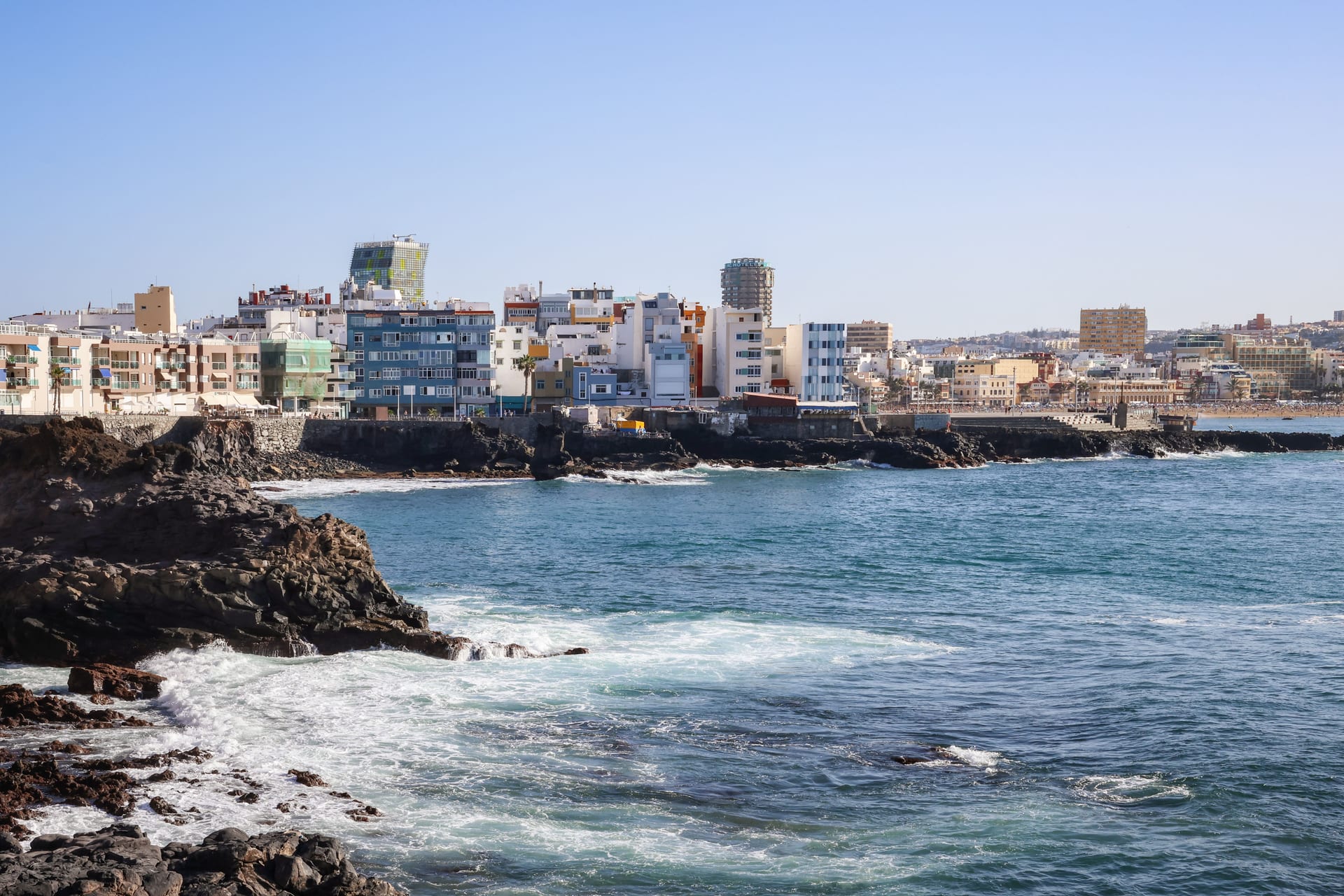
coastalThe ocean defines it, with some of the best beach and coastal access anywhere and a serious volcanic interior for hiking and mountain trips within weekend reach. Inside the city itself, though, green space is scarce, parks are limited and there are essentially no rivers or lakes, so nature here means the sea and the hills rather than leafy urban commons.
Urban form
mid-sizedA compact, low-rise city with an unhurried pace, calmer than busy Madrid and on a par with Málaga. The core is walkable and daily life rarely demands a car, though it spreads out rather than rising into a dense centre. The relaxed rhythm suits some and feels sleepy to others used to a bigger capital.
Public life & spaces
74/100Las Palmas keeps its beachfront and centre decently kept, with a few worn districts at the edges. The Las Canteras promenade, the plazas and the walkable old town make pleasant shared space. The real draw is affordability: this is a cheap corner of the Canaries, with beaches, festivals and free street life year-round.
Safety
75/100Reassuringly safe. Violent crime is very low, the roads are among the safer in the region, and walking around at night feels comfortable, in line with other Spanish cities. The main thing to stay alert to is everyday petty crime, the pickpocketing and opportunism common to tourist-heavy places, which sits at a middling level.
Healthcare
68/100Solid, dependable public healthcare without quite the depth of the big mainland hospitals in Madrid. Hospital access and emergency care are reliable and out-of-pocket costs stay low. English-speaking care is patchier than in Lisbon or Málaga, so some Spanish, or a private clinic used to foreigners, helps for anything complicated.
Family life
67/100An outdoor childhood is the strong suit, with year-round warmth, the beach and a relaxed work-life culture that leaves room for family time. Schools, childcare and playgrounds are decent rather than exceptional, and family-sized housing is more attainable than on the mainland. A genuinely safe environment for children rounds it out.
Career
50/100Local employment is the clear limitation in Las Palmas. Typical local pay is relatively solid, but the job market is narrow and startup options are modest. Remote work is unusually well supported, while English-language roles give newcomers some room, making portable income a stronger fit than local career building.
Culture & food
69/100A capable food and culture scene with a notably large international community, though a step down from the mainland heavyweights. Restaurants and local cooking are good, while cafes, nightlife, museums and the arts are present without the depth of Madrid or Lisbon. Lively enough day to day, quieter than people expecting a major city might want.
Ease of integration
70/100Spanish is the working language and learning some matters, though English goes a long way thanks to one of the larger international communities in Spain. Locals are fairly open to newcomers and cultural adjustment is gentle. The mix of relocated remote workers and welcoming residents makes settling in socially easier than in many mainland cities.
Connectivity
54/100A mixed picture. Internet is fast and the airport keeps the island connected to Europe, but the obvious gap is rail, with no intercity trains at all given the island geography, so getting around means buses or a car. Public transport is modest, congestion is manageable and utilities are reliable, if not best in class.
Social values
progressiveBroadly liberal and easygoing, with strong acceptance of LGBTQ residents and a welcoming stance toward foreigners shaped by decades of international visitors. It leans a touch more traditional than cosmopolitan Madrid or Berlin, but social attitudes are open and gender equality is on a par with the rest of urban Spain.
Relocation ease
56/100Moving here as an EU citizen is straightforward, and the language barrier is gentler than in much of Spain given how used the island is to outsiders. The friction shows up later, in slow bureaucracy and a tight, frustrating housing search, both common across Spanish cities. Cultural adjustment, by contrast, tends to be quick and painless.
The trade-offs
A year in Las Palmas de Gran Canaria
Aug peaks around 25°C, Jan days top out near 18°C, and the year brings roughly 312 bright days.
Can you actually move here?
The hard limits people most often bring to a move, scored against Las Palmas de Gran Canaria's data.
Moving with a pet
Bringing a pet is straightforward. As part of Spain and the EU, the island follows standard EU pet rules, so a microchip, rabies vaccination and pet passport cover most arrivals, with little extra paperwork beyond the journey itself.
Who Las Palmas de Gran Canaria works for
Answer the questionnaire and see where Las Palmas de Gran Canaria lands for you.
Take the free questionnaireWhere else to look
Las Palmas de Gran Canaria vs. comparable cities
Objective scores (0–100) for Las Palmas de Gran Canaria and its 4 nearest comparable cities.
The cities people weigh against Las Palmas de Gran Canaria
Unexpected siblings
Far from Las Palmas de Gran Canaria on the map, close across all 14 categories of daily life.