
Living in Surabaya
Indonesia's second city after Jakarta, Surabaya is a working port and industrial hub on Java's northeast coast, with little of the tourist polish of Bali. Daily costs sit near the bottom of the region. It is hot, humid year-round, heavily car-dependent, and noticeably more conservative than Jakarta or Bali.
Surabaya at a glance
Vital stats
Shown in USD: the local currency (IDR) moves too fast for stable monthly figures.
Where Surabaya stands out
The metrics where Surabaya sits farthest from the middle worldwide, good and bad.
Cheap to arrive, expensive to stay?
A typical one-bedroom in Surabaya runs $275/mo. That is beyond the mean net pay of a typical local employee. This is a solo-newcomer stress test: sitting tenants, shared homes, subsidised housing and informal rents are deliberately outside the numerator.
The fastest way to test a shortlist is to go. A week on the ground tells you things no ranking can.
Partner link
Approved language-learning and international money resources for practical next steps.
Daily life in Surabaya
How Surabaya scores
Category by category
Affordability
70/100Surabaya's open-market one-bedroom rent on a new lease is about $275 per month. The rent-to-income measure reaches its 120% ceiling against one typical employee's mean net pay, so the underlying burden may be higher; the band is beyond local pay.
Climate
tropicalSurabaya has little seasonal darkness and stays hot, but the heat comes with near-constant mugginess. July averages about 28°C, and the sky is often unsettled, with far more rainy-grey days than bright ones. Air quality is not as strong as the tropical warmth might suggest.
Nature access
alpineNot a city that delivers much green relief. Parks are limited and green space per resident is thin, beaches nearby are uninspiring compared with Bali's coast, and there is little forest or hiking close by. The volcanoes of East Java sit within weekend reach, which is the main outdoor draw.
Urban form
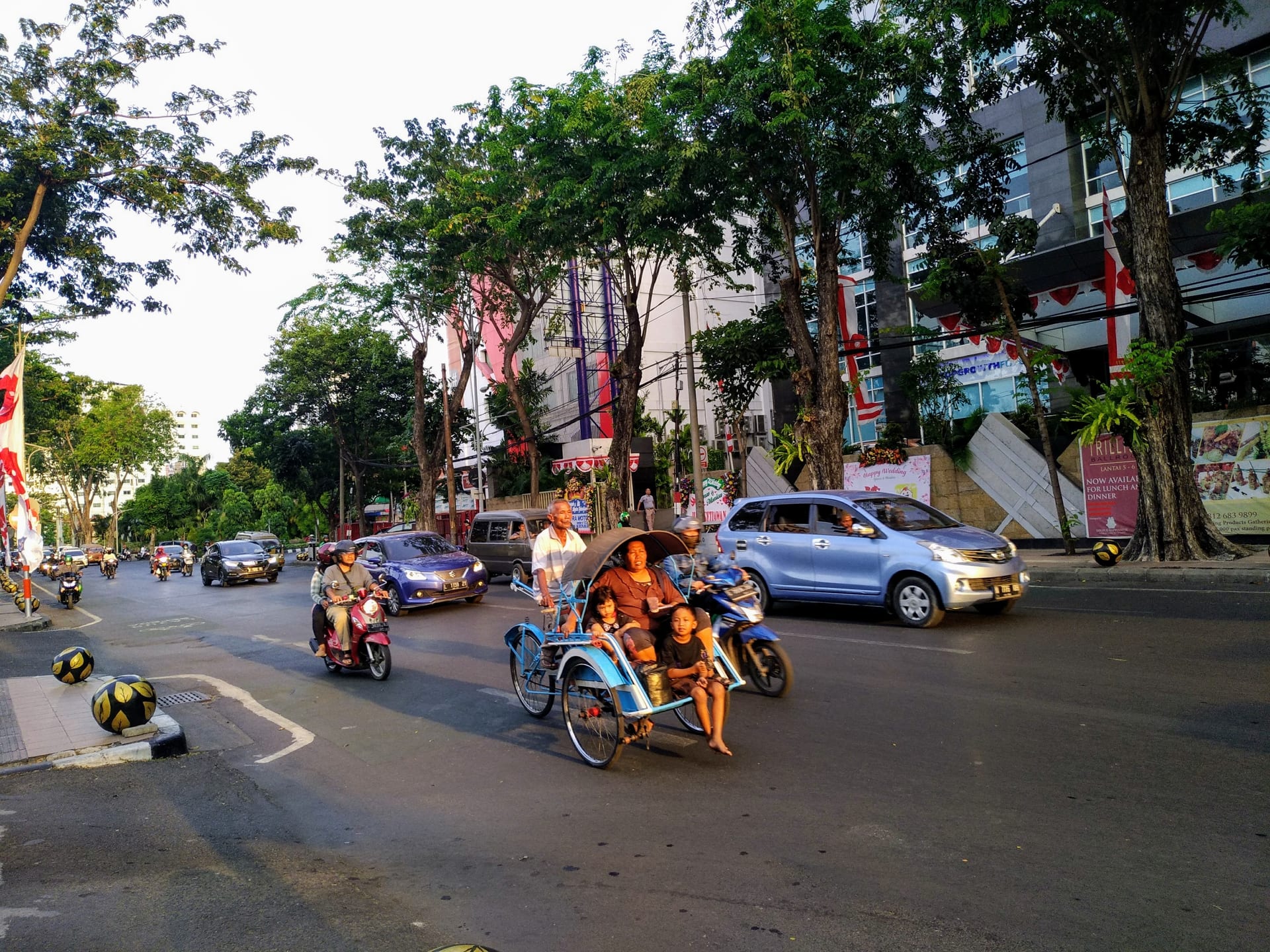
large cityA sprawling, car-and-motorbike city built around roads rather than footpaths. Walkability is poor and getting around without a vehicle is genuinely hard, more so than in Manila. Homes tend to come with more space than in denser hubs like Singapore, but neighbourhoods feel ordinary rather than distinctive.
Public life & spaces
48/100Surabaya is a hot, industrial Indonesian city with heavy traffic and only modest upkeep, its life pulled toward malls and cars rather than any walkable square, though a few renovated parks help. Living is cheap, but it offers fewer free events and facilities than the capitals. It's functional and affordable, not cared-for or lively.
Safety
59/100Violent crime is low and the homicide rate is among the region's lowest, on par with Bali and well below Manila or Mexico City. Most residents feel comfortable day and night. The real hazard is the traffic, where road safety lags far behind orderly cities, and the wider political climate is less stable than in Western Europe.
Healthcare
44/100Care is functional but middling. Private hospitals cover everyday needs and many doctors handle English reasonably well, yet the supply of physicians is thin and emergency reliability is uneven. Anyone with serious or complex conditions often travels to Singapore, a pattern common across this part of Indonesia.
Family life
39/100A workable place to raise children, without standout support. Childcare is affordable and easy to arrange, but schools and playground provision are average, and statutory parental leave is minimal compared with Europe. The relaxed, family-oriented social fabric helps, even if formal infrastructure for parents is limited.
Career
58/100Surabaya offers a steady local base and low unemployment, but the career ceiling is modest. English-language roles are scarce, and the business networks and technology scene are limited. Local pay is low, so the city makes more sense for a move with a local reason than for someone chasing income.
Culture & food
58/100Strong on everyday Indonesian eating, with rumah makan, warungs, and a growing cafe habit, though the dining ceiling is lower than Bali's. Nightlife and the arts scene stay modest. The international community is small and English goes a shorter way than in tourist-driven Indonesian destinations, so daily life leans firmly local.
Ease of integration
56/100Indonesian is the working language, with Javanese spoken widely and English far less common than in Bali or Manila. Locals tend to be warm and welcoming, but the language gap and a fairly traditional, religiously observant culture mean integration takes real effort. Building a foreign-leaning social circle is harder here than in more cosmopolitan hubs.
Connectivity
37/100The weak spot. Public transport is sparse, cycling provision is almost nonexistent, internet speeds trail regional peers, and government processes are barely digitized. Intercity rail across Java is a genuine plus and connects well to other cities. Day to day, expect to rely on a motorbike or ride-hailing apps.
Social values
traditionalSocially conservative, with a strongly religious public culture and limited room for visible nonconformity. Attitudes on LGBTQ life and social liberalism sit below even Bali and Manila, and gender norms are traditional. People are generally hospitable to visitors, but newcomers used to secular, liberal cities will feel the difference.
Relocation ease
46/100A demanding move on the paperwork side. Visas and work authorization are fiddly, banking and bureaucracy slow, and the language barrier is steeper than in much of Southeast Asia given how little English circulates. Cultural adjustment and finding housing are more manageable, but patience is essential for the official hurdles.
The trade-offs
A year in Surabaya
Sep peaks around 33°C, Jan days top out near 31°C, and the year brings roughly 128 bright days.
Can you actually move here?
The hard limits people most often bring to a move, scored against Surabaya's data.
Moving with a pet
Bringing a pet into Indonesia is moderately difficult, with import permits, vaccination and documentation requirements, and a process that runs slower than in many countries. Start early and budget time for the paperwork.
Who Surabaya works for
Answer the questionnaire and see where Surabaya lands for you.
Take the free questionnaireWhere else to look
Surabaya vs. comparable cities


Objective scores (0–100) for Surabaya and its 4 nearest comparable cities.
The cities people weigh against Surabaya
Unexpected siblings
Far from Surabaya on the map, close across all 14 categories of daily life.


