
Living in Cartagena
Cartagena brings Caribbean heat, with muggy conditions near constant and rainy-grey days common. The local market is thin and local pay is low, so the city suits residents with income from elsewhere better than people seeking a deep local job market.
Cartagena at a glance
Vital stats
Shown in USD: the local currency (COP) moves too fast for stable monthly figures.
Where Cartagena stands out
The metrics where Cartagena sits farthest from the middle worldwide, good and bad.
Cheap to arrive, expensive to stay?
A typical one-bedroom in Cartagena runs $385/mo. That is ~97% of one typical local employee’s mean net pay. This is a solo-newcomer stress test: sitting tenants, shared homes, subsidised housing and informal rents are deliberately outside the numerator.
The fastest way to test a shortlist is to go. A week on the ground tells you things no ranking can.
Partner link
Approved language-learning and international money resources for practical next steps.
Daily life in Cartagena
How Cartagena scores
Category by category
Affordability
71/100Cartagena's open-market one-bedroom rent on a new lease is about $385 per month. That is roughly 97% of one typical employee's mean net pay, a rent burden labelled solo unlikely.
Climate
tropicalCartagena is hot year-round, with both January and July averaging about 28°C. The heat comes with relentless humidity, muggy conditions on essentially every day, and 183 rainy-grey days that make the skies less dependable than the postcard suggests. Air quality is mixed rather than pristine.
Nature access
coastalThe draw here is the water: beaches and ocean access are excellent, with islands and Caribbean coastline a short trip away and protected natural areas within reach for a weekend. Inland nature is thin, though. There are no mountains or serious hiking nearby, parks inside the city are limited, and green space per resident is scarce.
Urban form
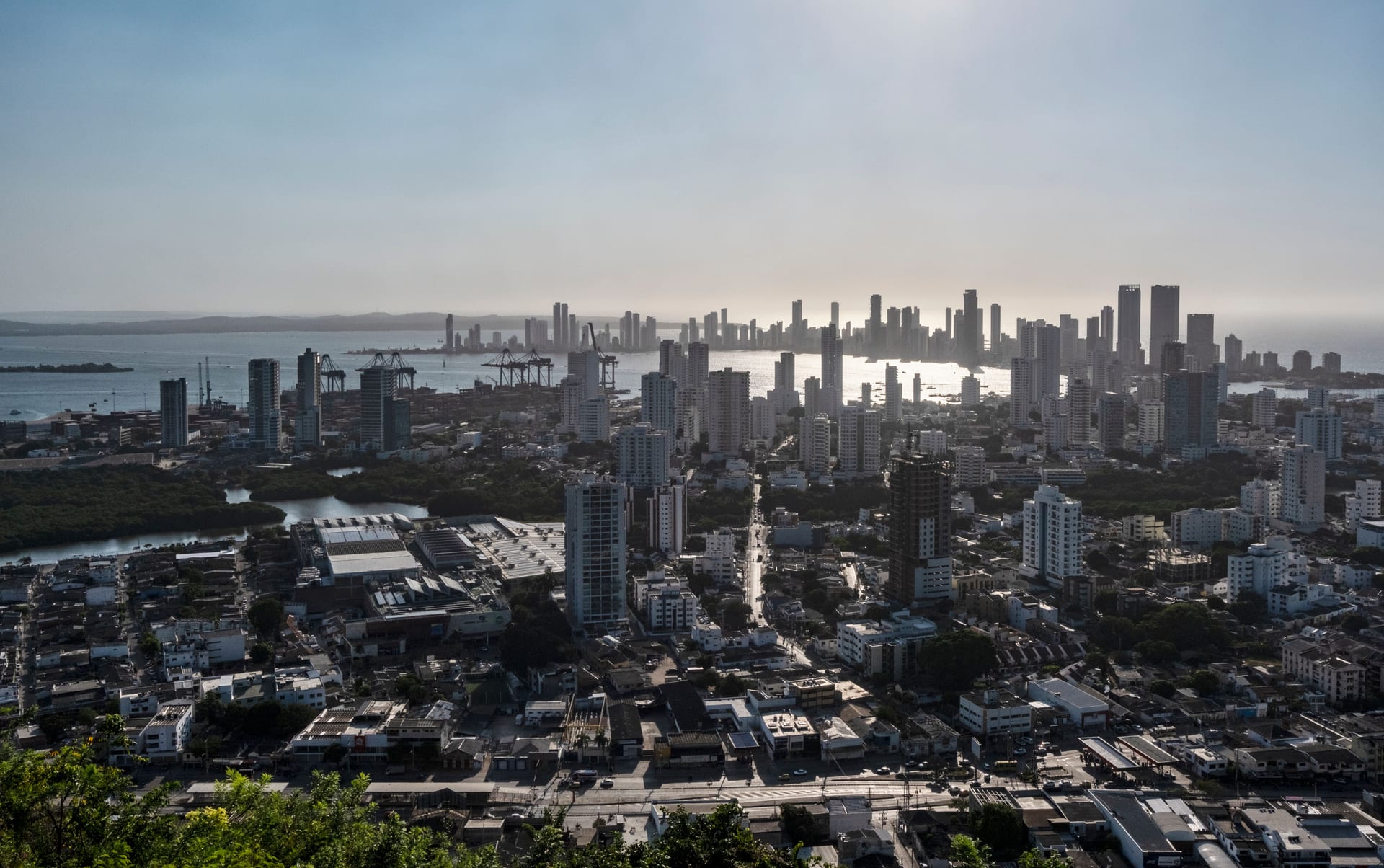
mid-sizedThis is a fairly compact coastal city rather than a sprawling metropolis, and the historic core is walkable in a way much of the modern city is not. Beyond the old quarter, getting around often means a car, and neighbourhood quality is uneven. The pace is slow and the scale modest compared with Bogotá or Medellín.
Public life & spaces
52/100Cartagena keeps its walled old town beautifully, its colonial plazas, ramparts, and waterfront among the finest in the Americas, though the outskirts are noticeably rougher. The contrast is sharp. Daily life is cheap by Colombian standards but tourist-priced inside the walls, where the plaza life itself, music and crowds at dusk, still costs nothing.
Safety
43/100Cartagena deserves more caution than its relaxed tourist image suggests. The homicide rate is about 39 per 100,000, while petty theft and violent-crime exposure remain high enough to shape how people move after dark. Political stability is also weak, so calm daytime streets should not be read as a full safety picture.
Healthcare
49/100Healthcare is workable but not a standout. The better private clinics offer decent care and some English-speaking staff, and out-of-pocket costs stay manageable. What thins out is access: doctors and hospital capacity are stretched, and emergency reliability is patchy, so anyone with complex medical needs would want to weigh that carefully.
Family life
42/100For families the appeal is an outdoor, beach-side childhood with affordable childcare. The harder parts are real, though. Schools are middling, child safety and family-friendly housing are only fair, and the local work culture offers little structural support for parents. It works best for families with flexibility and means rather than those relying on local systems.
Career
43/100The local market is thin, with limited industry breadth, few English-language roles, and little startup depth. Local pay is low, and unemployment is high. Remote work is not a substitute for a deep local ecosystem, but bringing income from elsewhere avoids the city's main career constraint.
Culture & food
68/100Cartagena has a strong sense of its own Caribbean culture, with lively nightlife, a solid restaurant and cafe scene, and music woven into daily life. The old city draws a steady international crowd. Plant-based eating is still underserved, and for newcomers, getting by socially leans heavily on Spanish. Culturally it feels distinct from highland Colombia.
Ease of integration
67/100Spanish runs daily life, and while there is a visible international presence around the old town and an openness to outsiders, building real local connections takes language. English speakers can find expat circles, but integrating beyond them means learning Spanish and adapting to a warm but tight-knit Caribbean social rhythm. Newcomers willing to do that tend to be welcomed.
Connectivity
28/100Infrastructure is basic. There is no intercity rail at all, public transport is limited, and cycling provision is poor, so daily movement depends on cars, taxis, and buses. The airport gives reasonable regional and some international links. Digital connectivity is the more dependable piece, while utilities can be inconsistent.
Social values
progressiveSocially the city is welcoming to foreigners and carries a real Caribbean diversity, but on broader liberal measures it sits middle-of-the-road, with traditional and conservative threads still strong. Gender equality and civic trust are weaker spots. Newcomers from more progressive places will find a friendly but more conventional social fabric than in some larger Colombian cities.
Relocation ease
51/100Formal entry is relatively manageable, with visa and work authorization among the easier parts of the move. Spanish remains the main gate, while bureaucracy and banking require patience. The current tax burden is about 20%, a lighter cost than in many places, but it does not remove the paperwork around settling in.
The trade-offs
A year in Cartagena
Feb peaks around 32°C, Jun days top out near 30°C, and the year brings roughly 127 bright days.
Can you actually move here?
The hard limits people most often bring to a move, scored against Cartagena's data.
Moving with a pet
Bringing a pet to Cartagena is reasonably straightforward. Colombia's import process for cats and dogs is among the easier in the region, generally requiring up-to-date vaccinations and a health certificate rather than long quarantine, so most owners can plan a move without major obstacles.
Who Cartagena works for
Answer the questionnaire and see where Cartagena lands for you.
Take the free questionnaireWhere else to look
Cartagena vs. comparable cities

Objective scores (0–100) for Cartagena and its 4 nearest comparable cities.
The cities people weigh against Cartagena
Unexpected siblings
Far from Cartagena on the map, close across all 14 categories of daily life.


