
Living in Bogotá
Bogotá is a cool, overcast capital where bright days are scarce but muggy heat is almost absent. Daily costs are low, yet typical local pay is low by the standards of the cities covered and the local market has clear limits, making remote income especially valuable. Spanish is important for settling in.
Bogotá at a glance
Vital stats
Shown in USD: the local currency (COP) moves too fast for stable monthly figures.
Where Bogotá stands out
The metrics where Bogotá sits farthest from the middle worldwide, good and bad.
Cheap to arrive, expensive to stay?
A typical one-bedroom in Bogotá runs $510/mo. That is ~97% of one typical local employee’s mean net pay. That is 0 points above Cartagena, its closest rival among nearby cities. This is a solo-newcomer stress test: sitting tenants, shared homes, subsidised housing and informal rents are deliberately outside the numerator.
The fastest way to test a shortlist is to go. A week on the ground tells you things no ranking can.
Partner link
Approved language-learning and international money resources for practical next steps.
Daily life in Bogotá
How Bogotá scores
Category by category
Affordability
71/100Bogotá's open-market one-bedroom rent on a new lease is about $510 per month. That is roughly 97% of one typical employee's mean net pay, a rent burden labelled solo unlikely.
Climate
coldBogotá stays cool throughout the year, with almost no muggy weather, but light is scarce and rain is frequent. Only 46 days are bright, while 183 are rainy and grey, so daily life feels damp and overcast rather than tropical. Air quality is a secondary drawback.
Nature access
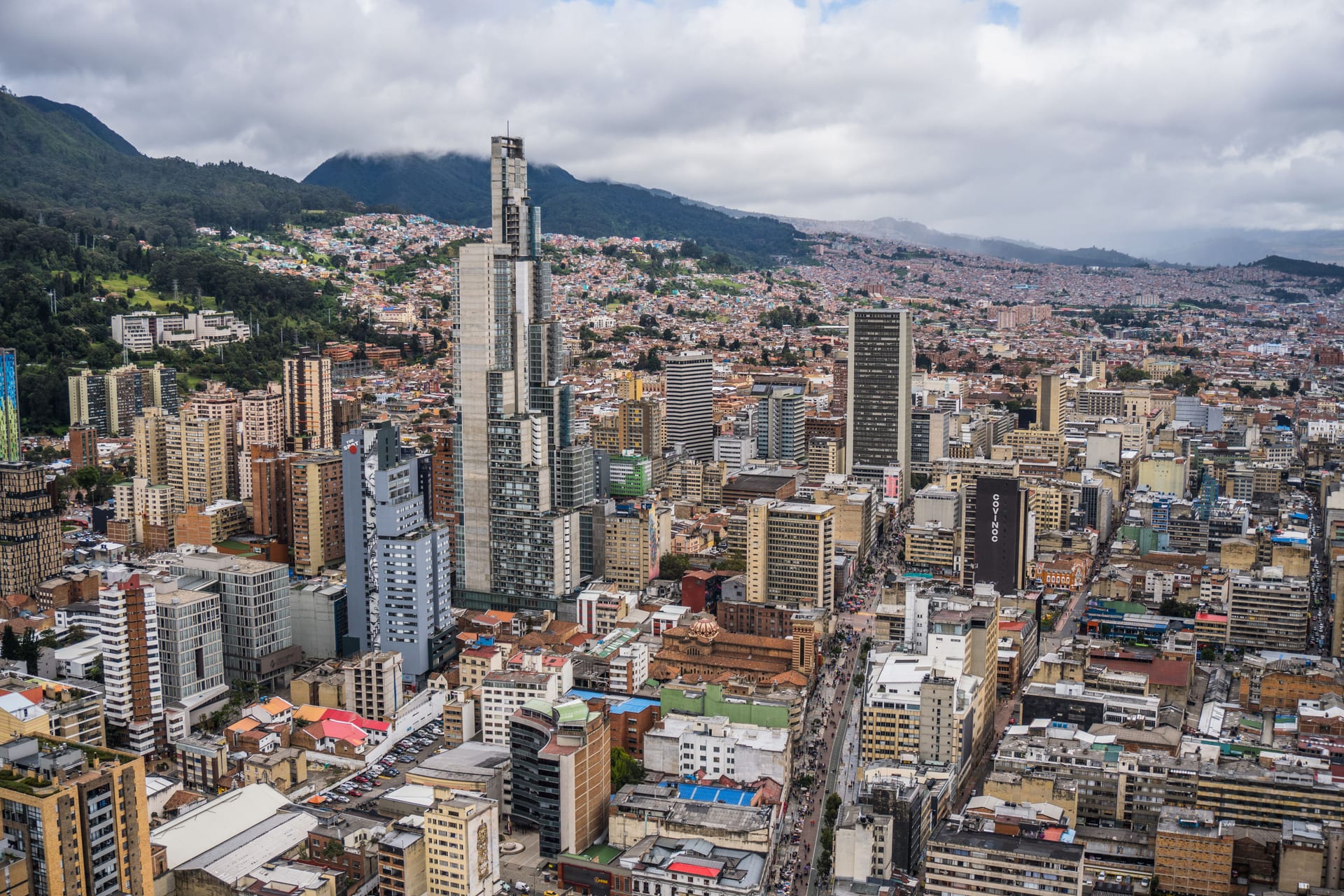
alpineThe mountains are the headline here, with the Andean ridgeline rising straight off the eastern edge of the city and good hiking close at hand. Weekend escapes into highland scenery come easily. Inside the city, green space per resident runs low, and being landlocked deep in the interior means the coast is a flight away rather than a drive.
Urban form
megacityThis is a sprawling, dense metropolis on the scale of Mexico City, far bigger than Medellín, and it moves at a brisk urban pace. Neighbourhoods vary widely in character and quality. Walkability is patchy and a car still helps in much of the city, even as mixed-use districts give central areas a real street life.
Public life & spaces
52/100Bogota is grimy in patches and unevenly kept, though central zones are slowly improving. The payoff is its public life: La Candelaria's plazas, leafy parks, and the Sunday ciclovia that hands whole avenues to walkers and cyclists. It's cheap, with free museums and concerts and a street culture that runs all week, grit and all.
Safety
40/100Safety is the hard part of living in Bogotá. Petty crime and street theft are common, and perceived safety after dark stays low, lower than in Medellín. The homicide picture has improved and reads better than the city's reputation suggests, but political stability is shaky, and residents tend to stay alert about where and when they move around.
Healthcare
55/100Healthcare is solid for the region, with reputable private hospitals and care that edges ahead of Mexico City on access. Doctor availability is stretched and emergency reliability is uneven, so the private system carries much of the load. Some English-speaking practitioners exist, though Spanish makes navigating treatment far smoother.
Family life
47/100Bogotá is a workable but not easy place to raise children. Childcare is reasonably available and affordable, and there are parks to use, but child safety scores low and the long-hours work culture leaves little family time. Parental leave is thin by European standards, on par with the rest of Colombia.
Career
64/100Bogotá has a credible local market and a real startup and technology base. Typical local pay is low by the standards of the cities covered, unemployment is high, and English-language roles are limited. Remote work is workable, but local career building demands more patience.
Culture & food
75/100Culture is where Bogotá comes alive, with serious museums, a strong music and art scene, dense nightlife, and a café culture fed by the country's coffee. Local food traditions run deep and the restaurant range is wide, broader than Medellín if short of Mexico City's depth. Little of it surfaces in English, so Spanish opens the real city.
Ease of integration
59/100Daily life runs almost entirely in Spanish, with English far less useful here than in the Caribbean Colombian cities. Locals are warm and fairly open to foreigners, but the international community is modest and integration leans heavily on the language. Newcomers who arrive with usable Spanish, or commit to learning, find connection comes much faster.
Connectivity
46/100Infrastructure is a mixed bag. Internet is fast and cycling lanes are unusually extensive for Latin America, a point of pride, but traffic congestion is punishing and there is no intercity rail, so the airport handles long-distance travel. Bureaucracy stays largely analogue, and getting official tasks done can be slow.
Social values
progressiveBogotá is the more progressive end of Colombia, more secular and socially liberal than smaller cities, with relative openness on LGBTQ life for the region. Even so, attitudes sit well short of Western European norms, and civic trust in institutions runs low. Gender equality is improving but still a work in progress.
Relocation ease
51/100Visas and work authorization are relatively manageable, and housing searches are reasonably straightforward. The real hurdle comes after arrival: language, bureaucracy, and banking all demand patience, while cultural adjustment takes time. The paperwork is less of a barrier than handling daily life without Spanish.
The trade-offs
A year in Bogotá
Jan peaks around 18°C, Mar days top out near 17°C, and the year brings roughly 46 bright days.
Can you actually move here?
The hard limits people most often bring to a move, scored against Bogotá's data.
Moving with a pet
Bringing a pet to Bogotá is reasonably straightforward, easier than into much of Europe, needing standard vaccinations and health paperwork rather than long quarantine. Lining up the veterinary certificates ahead of the flight is the main task.
Who Bogotá works for
Answer the questionnaire and see where Bogotá lands for you.
Take the free questionnaireWhere else to look
Bogotá vs. comparable cities

The cities people weigh against Bogotá
Unexpected siblings
Far from Bogotá on the map, close across all 14 categories of daily life.


