
Living in Okinawa (Naha)
Naha is the capital of Japan's subtropical southern islands, a slow, ocean-facing city that feels a world away from Tokyo or Osaka. Rents are gentle and the coast is everywhere, but careers are thin and getting around without a car is hard. Life here trades ambition for ease.
Okinawa (Naha) at a glance
Vital stats
Where Okinawa (Naha) stands out
The metrics where Okinawa (Naha) sits farthest from the middle worldwide, good and bad.
Cheap to arrive, expensive to stay?
A typical one-bedroom in Okinawa (Naha) runs ¥55,898/mo. That is ~32% of one typical local employee’s mean net pay. This is a solo-newcomer stress test: sitting tenants, shared homes, subsidised housing and informal rents are deliberately outside the numerator.
The fastest way to test a shortlist is to go. A week on the ground tells you things no ranking can.
Partner link
Approved language-learning and international money resources for practical next steps.
Daily life in Okinawa (Naha)
How Okinawa (Naha) scores
Category by category
Affordability
71/100Okinawa (Naha)'s open-market one-bedroom rent on a new lease is about ¥55,898 per month. That is roughly 32% of one typical employee's mean net pay, a rent burden labelled manageable solo.
Climate
tropicalWarmth lasts through the year in Okinawa, with mild winters and little seasonal darkness. The price is persistent humidity, with roughly 251 muggy days and only 142 bright days annually, alongside a long grey-rainy season. Air quality is excellent, but storm exposure is a meaningful part of island life.
Nature access
coastalThe ocean defines daily life here in a way few Japanese cities can match, with beaches and coral reefs essentially on the doorstep. Coastal national parks and outlying islands make for easy weekend escapes. What it lacks is the inland variety of mainland Japan, with little mountain country and modest green space within the city.
Urban form
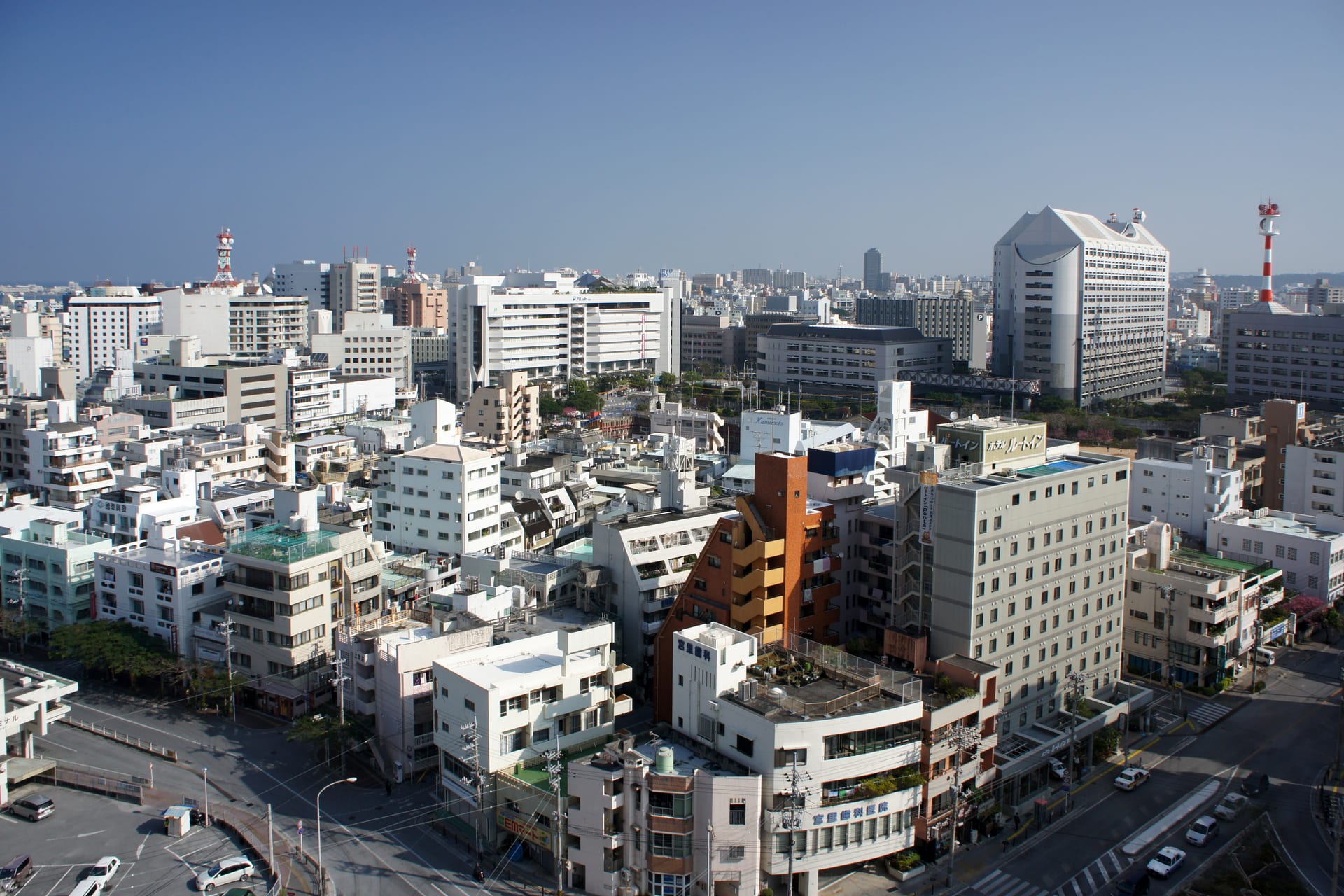
large cityThis is a small island capital, not a metropolis, and it shows. Naha is compact and low-rise, with walkable central pockets but heavy reliance on a car once you leave them. The pace is unhurried, far gentler than mainland hubs like Fukuoka or Osaka, which suits some and frustrates others.
Public life & spaces
74/100Okinawa is clean in the Japanese way, though it sprawls more than mainland cities, threaded with car roads and base areas. The beaches are the real public space; built squares are few and car-dependent. The coast is free and life runs cheaper, but festivals and sights carry tourist pricing.
Safety
91/100About as safe as it gets, even by Japan's high standards. Violent crime is rare, streets feel secure after dark, and the everyday sense of safety is total. Traffic is orderly and the wider political backdrop is stable. For families and solo movers alike, this is a place where worry simply isn't part of the day.
Healthcare
62/100Care is solid and runs through Japan's national insurance system, so out-of-pocket exposure stays manageable. Hospitals and emergency cover are dependable if not abundant, and as an island prefecture it has fewer doctors per head than the big mainland cities. English-speaking medical staff are scarce, so newcomers should expect to navigate appointments in Japanese.
Family life
67/100A genuinely good place to raise children, anchored by exceptional safety and an outdoor, beach-centred childhood that mainland cities can't easily offer. Schools are reliable and playgrounds plentiful. Childcare and family housing are workable rather than generous, and work-life balance is steady, helped by the slower island rhythm.
Career
39/100Okinawa's local job market is narrow, with shallow professional networks and little startup depth. Local pay is low by the wider benchmark, and English-first roles are scarce. Remote work broadens the options, but the local employment base remains a constraint for anyone relying on local hiring.
Culture & food
65/100Okinawan culture stands apart from mainland Japan, with its own cuisine, music, and an islander identity that residents take real pride in. Naha has a respectable spread of restaurants, cafes, and a low-key nightlife. The arts and museum scene is modest, and language remains a barrier to plugging in quickly, but the distinct local character runs deep.
Ease of integration
48/100Japanese is essential for genuine connection here, as English goes only so far in daily life. There's a foreign and US-base-linked community to lean on early, but integrating into local circles takes patience and language effort. Okinawans are known for a warm, communal streak, and civic trust runs high, which helps once the first walls come down.
Connectivity
43/100Functional but limited, and shaped by island geography. There are no intercity trains at all, public transport leans on buses and a single monorail, and most residents drive. The airport keeps Naha connected to the mainland and beyond. Digital and utility services are decent, while bureaucracy stays paper-heavy and slow to digitize.
Social values
mixedOrderly and high in civic trust, with a public culture that is largely secular and easygoing. On social attitudes it sits closer to traditional than progressive, with gender equality and openness to outsiders lagging the more cosmopolitan mainland cities. Day to day it feels relaxed and unbothered, though deeper acceptance as a newcomer can be slow.
Relocation ease
45/100Moving in is moderately involved. Visa and work-authorization paths are the standard Japanese routes, neither easy nor punishing, but the language barrier is steep and cultural adjustment takes time, more so on a distinctly local island than in international Tokyo. Banking, housing searches, and bureaucracy all run smoother with Japanese and local help.
The trade-offs
A year in Okinawa (Naha)
Jul peaks around 29°C, Jan days top out near 19°C, and the year brings roughly 142 bright days.
Can you actually move here?
The hard limits people most often bring to a move, scored against Okinawa (Naha)'s data.
Moving with a pet
Bringing a pet to Japan is a long, strictly scheduled process built around rabies titre testing and months of advance paperwork, so plan well ahead. Okinawa follows the same national rules with no island-specific shortcuts, making it manageable but far from quick.
Who Okinawa (Naha) works for
Answer the questionnaire and see where Okinawa (Naha) lands for you.
Take the free questionnaireWhere else to look
Okinawa (Naha) vs. comparable cities
The cities people weigh against Okinawa (Naha)
Unexpected siblings
Far from Okinawa (Naha) on the map, close across all 14 categories of daily life.

