
Living in Zagreb
Zagreb is a small, easy-paced capital with a reasonably bright overall year but a distinctly dim winter. Local pay is modest, and the narrow job market means remote or portable income changes the equation. The city fits residents seeking a manageable base more than a deep career market.
Zagreb at a glance
Vital stats
Where Zagreb stands out
The metrics where Zagreb sits farthest from the middle worldwide, good and bad.
Cheap to arrive, expensive to stay?
A typical one-bedroom in Zagreb runs €655/mo. That is ~47% of one typical local employee’s mean net pay. This is a solo-newcomer stress test: sitting tenants, shared homes, subsidised housing and informal rents are deliberately outside the numerator.
The fastest way to test a shortlist is to go. A week on the ground tells you things no ranking can.
Partner link
Approved language-learning and international money resources for practical next steps.
Daily life in Zagreb
How Zagreb scores
Category by category
Affordability
70/100Zagreb's open-market one-bedroom rent on a new lease is about €655 per month. That is roughly 47% of one typical employee's mean net pay, a rent burden labelled tight alone.
Climate
temperateZagreb has a properly continental climate, with cold winters and warm summers. It gets about 201 bright days a year and relatively few rainy-grey days, yet winter brightness is limited enough to make the darker months noticeable. Air quality is middling, while severe-weather risk stays low.
Nature access
forestedThe real draw is what sits within a short drive rather than inside the city. Forests, hills and national parks are genuinely close, and weekend trips into mountains or toward the Adriatic coast are part of life here. Inside Zagreb itself, green space per resident is thinner, and the sea is a drive away rather than on the doorstep.
Urban form
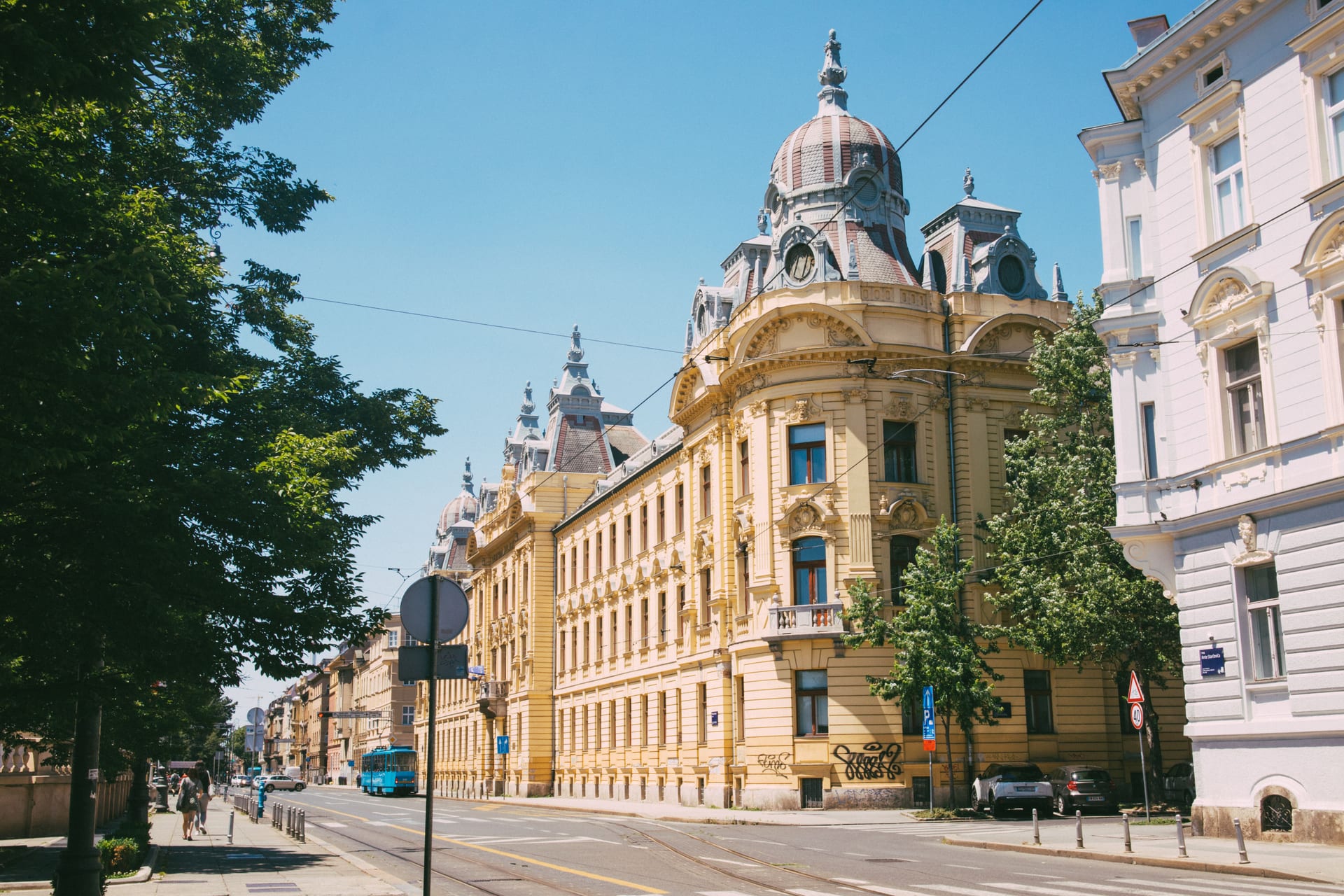
mid-sizedThis is a compact, human-scaled capital, much smaller and less dense than Budapest or Prague. The centre is highly walkable and most errands work without a car, which keeps daily life calm. The flip side is tempo: the city moves slowly and quietly, so people who want a fast, big-city churn will find it sleepy.
Public life & spaces
67/100Zagreb's Austro-Hungarian centre is orderly and well-kept, tidy in a way that flatters its squares, parks and the buzzing Dolac market. Public space here is solid and walkable. Living stays affordable, with free festivals, leafy parks and an easy outdoor cafe culture that costs little.
Safety
80/100Safety is a clear strength. Violent crime is rare, petty theft is low for a European capital, and walking home late generally feels fine across the city. Residents report a strong everyday sense of security, in line with the quiet reputation of the wider region. Traffic is reasonably orderly and the political backdrop is stable.
Healthcare
63/100Healthcare is solid but middling rather than exceptional. Public hospitals and emergency care are dependable for routine needs, and out-of-pocket costs stay manageable. Specialist depth and doctor availability trail the strongest Central European systems, and English in clinical settings is hit-or-miss, so newcomers may lean on private clinics or a translator for complex care.
Family life
61/100For families, the appeal is a safe, outdoorsy, unhurried environment with a sane work-life rhythm and plenty of playgrounds. The weaker points are schools and childcare, where quality and availability lag Prague, Budapest and Berlin. Family-sized housing is affordable to rent compared with much of Europe, which eases one of the bigger pressures of raising kids in a capital.
Career
55/100Zagreb's local job market is thin, with modest industry breadth and limited professional-network depth. Unemployment is 5%, while English-language roles are available and remote work is a genuine strength. Local pay is modest, so the city is more convincing for location-flexible income than for rapid local advancement.
Culture & food
69/100Cafe life is the heartbeat here, with terrace-sitting treated as a civic ritual, and the restaurant and museum scene holds its own against Budapest and Prague. Nightlife is gentler than those two, and the international and vegetarian dining scenes are still catching up. It is a place with a strong, distinct local culture rather than a globalised one.
Ease of integration
48/100Croatian is the language of daily life, with English widely spoken among younger people and German common too. Locals are reasonably open to foreigners, a touch warmer than some neighbours to the north, though the expat community is smaller than in larger capitals. Real integration leans on picking up some Croatian, since deeper social circles still run in the local language.
Connectivity
53/100Infrastructure is a mixed picture. Public transport, trams and utilities are reliable and cover the compact city well. Where it falls short is reach beyond the city: the airport offers limited direct routes, intercity rail is slow and sparse, and home internet speeds trail the regional frontrunners. Everyday admin runs more on paper than screens.
Social values
mixedSocially, Zagreb leans more traditional and religiously rooted than Prague, Berlin or Lisbon, sitting in the more conservative half of European capitals. Attitudes toward gender and LGBTQ life are middling and slowly liberalising, with the capital noticeably more open than rural Croatia. Newcomers from very secular, progressive cities should expect a more conventional public culture.
Relocation ease
60/100Settling in is moderate going. Visa and residence paths are relatively approachable within the EU framework, but local bureaucracy is heavy and largely manual, and the housing search can be slow without local contacts. The language barrier is real outside of younger and professional circles. Banking and tax setup are workable, if rarely quick.
The trade-offs
A year in Zagreb
Jul peaks around 29°C, Jan days top out near 6°C, and the year brings roughly 201 bright days.
Can you actually move here?
The hard limits people most often bring to a move, scored against Zagreb's data.
Moving with a pet
Bringing a pet to Zagreb is straightforward. As an EU country with standard pet-import rules, Croatia mainly needs the usual microchip, rabies vaccination and EU pet passport or health certificate, with no lengthy quarantine for typical arrivals.
Who Zagreb works for
Answer the questionnaire and see where Zagreb lands for you.
Take the free questionnaireWhere else to look
Zagreb vs. comparable cities


The cities people weigh against Zagreb
Unexpected siblings
Far from Zagreb on the map, close across all 14 categories of daily life.


